
Security Questionnaire: What It Is and How to Respond

Security questionnaires are no longer a rare administrative step; they’re a fundamental barrier in modern vendor and sales processes. The average enterprise security assessment now contains hundreds of questions and takes teams 23–35 hours to complete, often delaying deals by 6–8 weeks when done manually.
74% of data breaches involve third-party vendors, yet less than half of organizations consistently use structured questionnaires during onboarding, the gap between security expectations and operational execution has become a competitive firing line.
This blog explains how security questionnaires function, why they slow you down, and practical methods to accelerate responses without sacrificing accuracy, turning what used to be a sales bottleneck into a strategic capability.
TL;DR (Core Takeaways)
Security questionnaires move faster when irrelevant questions are removed early.
A centralized knowledge base eliminates repetitive work.
Clear remediation plans strengthen credibility with prospects.
Prior questionnaires are valuable reference material for speed and consistency.
Accurate, concise answers build trust and reduce unnecessary follow-ups.
What Is a Security Questionnaire?
A security questionnaire is a structured set of technical and procedural questions used to assess a vendor’s ability to safeguard sensitive data. These questionnaires, typically created by IT or security teams, help organizations verify whether a third party meets required security standards before granting any data or system access.
Although the format varies across companies, the purpose is consistent: determine if a vendor’s controls, policies, and practices are strong enough to protect customer information. Security questionnaires are now a standard part of vendor evaluations across industries, serving as a critical checkpoint in the procurement process.
They help teams confirm:
Whether required security controls exist and function as intended
How data is stored, accessed, encrypted, and monitored
The vendor’s readiness to detect, respond to, and recover from incidents
Alignment with frameworks, certifications, or regulatory expectations
Put simply, security questionnaires offer a structured way to decide if a third party can be trusted with your data, backed by evidence, not assumptions.
Why Security Questionnaires Matter
Short answer: they’re the primary tool for proving a vendor can handle your data and for limiting the downstream risk you inherit.
You inherit vendor risk the moment you share data. When a third party has access to sensitive systems or PII, any breach or security failure on their side becomes your incident risk, too.
The consequences are concrete and costly. A vendor-caused incident can trigger regulatory penalties, financial losses, litigation, and long-lasting reputational damage.
Questionnaires turn claims into evidence. A well-constructed security questionnaire collects consistent, comparable answers and documents controls, so you can evaluate whether a vendor meets your minimum requirements.
They improve vendor readiness. The process highlights gaps in a provider’s security and incident response plans, creating a roadmap for remediation before problems occur.
Security questionnaires are not paperwork for their own sake, they’re the factual basis for vendor decisions and the first line of defense against third-party exposure.

What Security Questionnaires Typically Cover
Security questionnaires often dive deep into your organization’s controls, processes, and technical safeguards. While the structure varies across vendors, most questionnaires revolve around a core set of security domains that help assess how well your environment can prevent, detect, and respond to risk. These domains usually include:
Application & Interface Security
Audit Assurance and Compliance
Business Continuity & Operational Resilience
Data Center Security
Encryption & Key Management
Governance & Risk Management
Identity & Access Management
Infrastructure Security
Hiring & Personnel Policies
Security Incident Management
Supply Chain Transparency & Accountability
Threat & Vulnerability Management
Even though the content may feel repetitive, long, and at times overly detailed, some security questionnaires exceed 300 items, your answers carry real weight. A single incorrect claim can create legal exposure. If your organization marks a control as implemented and a breach later proves otherwise, you could face contractual penalties and liability for damages. Accuracy is non-negotiable.
Most teams struggle not because they lack controls, but because they can’t prove them consistently across hundreds of assessments. Auditive eliminates that risk.
Industry-Standard Security Questionnaires
Security questionnaires follow a handful of well-recognized models. Each one serves a distinct purpose, depending on whether you’re assessing cloud providers, federal contractors, high-risk vendors, or general cybersecurity posture. Below is a refined, high-value overview so teams know exactly when and why to use each questionnaire, not just what they are.
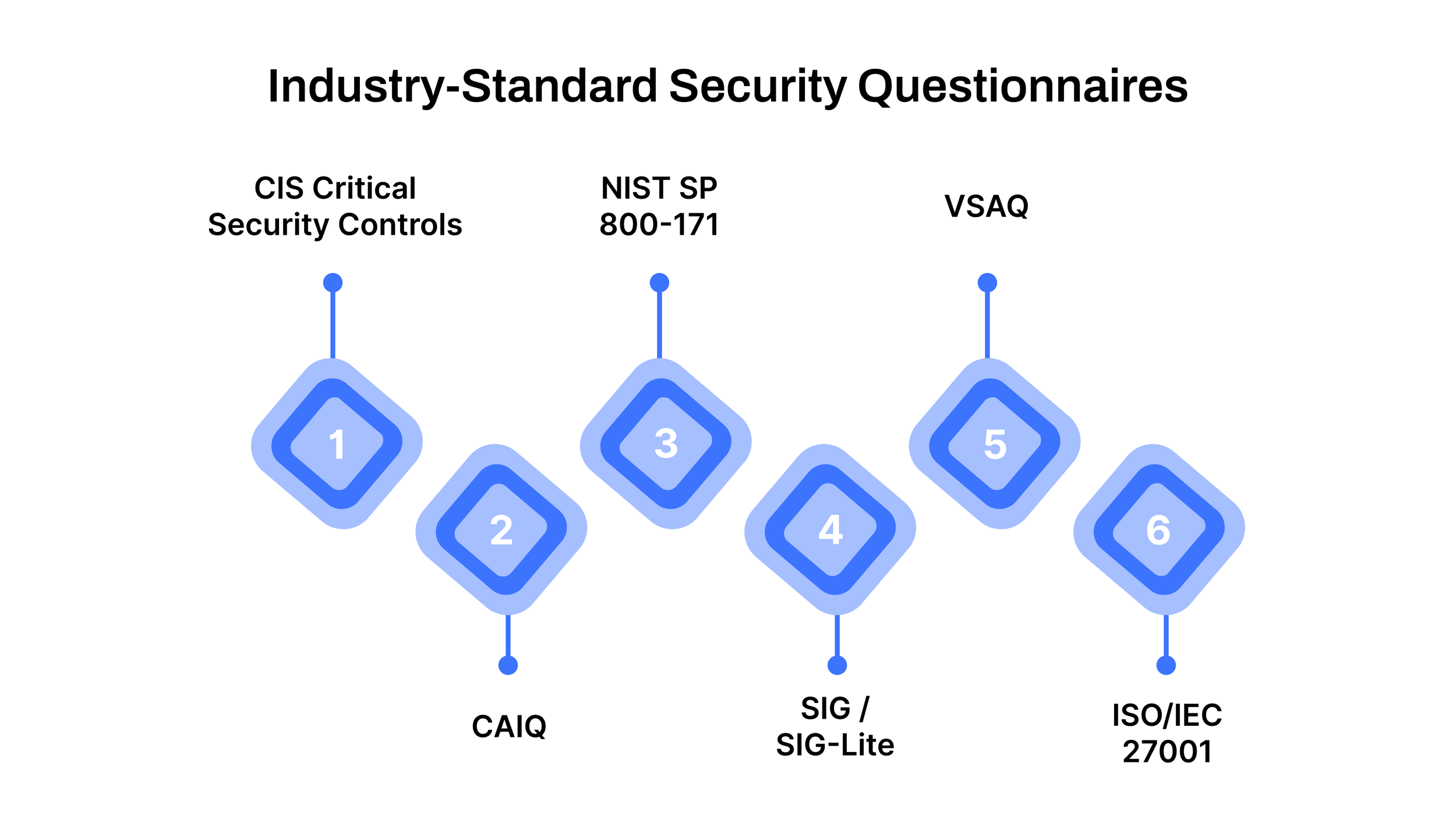
CIS Critical Security Controls (CIS Top 18): Prioritized, Practical, Widely Mapped
The CIS Top 18 is one of the most operationally useful foundations for evaluating vendor security. It lists a prioritized set of actions, covering asset management, secure configuration, vulnerability management, logging, access controls, and more.
What makes it valuable for security questionnaires:
It maps cleanly to NIST CSF, NIST 800-53, ISO 27001, PCI DSS, HIPAA, FISMA, and sector-specific regulations.
It emphasizes implementation maturity, not surface-level claims.
It creates a consistent baseline across vendors with different technical stacks.
Use CIS-based questionnaires when you want a measurable, control-focused assessment rather than long narrative responses.
CAIQ (CSA Consensus Assessments Initiative Questionnaire): Cloud-Focused and Highly Standardized
CAIQ is built for assessing SaaS, PaaS, and IaaS providers. It drills directly into cloud-specific topics, data isolation, virtualized environments, tenant segmentation, identity models, logging, encryption, and shared responsibility boundaries.
Why it matters:
It’s the closest thing to a universal questionnaire for cloud vendors.
It follows the Cloud Security Alliance’s CCM (Cloud Controls Matrix).
It shortens review cycles because most reputable cloud vendors already maintain current CAIQ versions.
Choose CAIQ when evaluating any cloud-native or cloud-delivered product, it gives quick clarity and reduces back-and-forth.
NIST SP 800-171: Required for Federal Work, Critical for CUI Protection
NIST 800-171 defines the safeguards needed to protect Controlled Unclassified Information (CUI) in non-federal systems. The framework includes 14 security domains covering access control, incident response, audit logging, configuration management, and more.
Why it matters:
Mandatory for vendors supporting DoD, GSA, NASA, and other US federal entities.
Explicitly maps to NIST 800-53 and ISO 27001.
Offers a clear scoring model that organizations can track over time.
Use NIST 800-171 questionnaires when handling federal contracts, subcontractor evaluations, or environments where CUI or ITAR-related data may be present.
Suggested read: NIST Risk Management Framework: Steps and Overview Guide
SIG / SIG-Lite (Shared Assessments): Comprehensive, Risk-Aligned Vendor Evaluation
The SIG suite is designed specifically for third-party risk assessments, covering cybersecurity, IT, privacy, data security, operational resilience, and business continuity.
What sets SIG apart:
Extremely comprehensive, ideal for high-risk vendors.
SIG-Lite offers a shorter, high-level version for lower-risk or early-stage qualification.
Questions are evidence-driven and align with major frameworks, enabling broader cross-mapping.
Use SIG/SIG-Lite when you need one questionnaire that covers every major risk domain without stitching multiple frameworks together.
VSAQ (Vendor Security Alliance Questionnaire): Operational and Supply-Chain Focused
VSAQ examines vendor practices across six areas, including data protection, governance, incident response, supply-chain controls, and preventive/reactive security measures.
Why it stands out:
Designed by large industry players to create practical, review-friendly questionnaire sets.
Strong coverage of supply chain risk, which is increasingly critical.
Useful for vendors without formal certifications but with mature internal practices.
Choose VSAQ when evaluating vendors that support critical workflows or have deep integrations into your environment.
Must read: Top Vendor Security and Privacy Assessment Software for 2025
ISO/IEC 27001: Certification Validation With Evidence-Backed Controls
ISO 27001 isn’t a questionnaire by itself, but it’s one of the most important signals of vendor security maturity. An organization certified to ISO 27001 has implemented a formal Information Security Management System (ISMS) aligned with internationally recognized standards.
Where it helps:
Provides traceability across ~114 controls (Annex A).
Reduces questionnaire volume because evidence can map to multiple controls.
Serves as a globally trusted validation for enterprise vendors.
Use ISO-aligned checks to streamline evidence requests and reduce repetitive security questionnaires.
Auditive eliminates the manual friction behind security questionnaires by centralizing evidence, auto-mapping responses, and continuously monitoring vendor posture. Auditive maps the answers to frameworks like CIS, NIST, and ISO.
Learn more about: What is ISO Compliance and Its Importance
How to Create Faster Security Questionnaire Responses
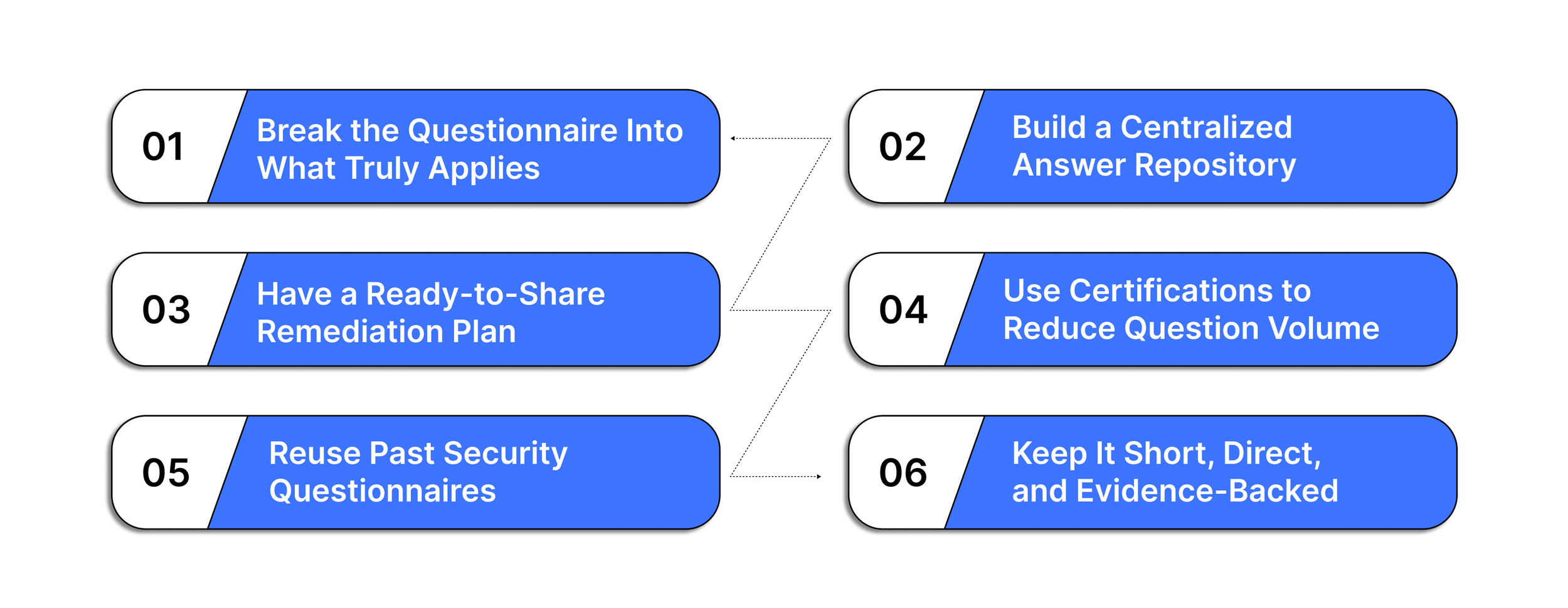
Answering security questionnaires isn’t difficult because of complexity, it’s difficult because every customer asks questions differently, evidence is scattered, and teams scramble to align on answers. Speed comes from structure, not shortcuts. The following refined steps will help teams respond faster while staying accurate and audit-safe.
1. Break the Questionnaire Into What Truly Applies
Start by restructuring the questionnaire into a format your team can actually work with, by relevance, not by order.
Most questionnaires contain sections that don't match your tech stack or processes; acknowledging this early prevents wasted time and avoids creating unnecessary evidence.
What adds real speed here:
Flag non-applicable items with short, factual justifications that eliminate follow-up.
Note dependencies (“This control aligns with X policy; see attached evidence”).
Ask for clarification when the intent is unclear; unanswered ambiguity slows down approvals more than any delay in asking questions.
Map each question to internal stakeholders before writing anything; misrouted questions create the largest bottlenecks.
When you make the questionnaire smaller, clearer, and internally routed before answering, the entire response cycle compresses on day one.
2. Build a Centralized Answer Repository
A centralized answer repository is the single biggest multiplier for response speed. Instead of reinventing explanations every time, teams pull from vetted, pre-approved content.
What makes a repository valuable:
Store high-quality, reviewed answers with supporting evidence.
Categorize responses by framework, control owner, function, and recurring themes.
Maintain version control so no one copies outdated information into a new assessment.
Attach artifacts (policies, diagrams, and reports) directly to the answers, reducing back-and-forth with sales, legal, and engineering.
Over time, the repository becomes a “response engine,” reducing days of work to minutes while ensuring accuracy stays intact.
3. Have a Ready-to-Share Remediation Plan
No security program is perfect, and questionnaires make that visible. What matters is not whether gaps exist, it’s how clearly you show your plan to close them.
What a good remediation plan includes:
The identified gap or missing control
A defined owner
A realistic timeline
Specific corrective actions
A follow-up assessment opportunity
Customers appreciate transparency more than perfection. A clear plan signals accountability, maturity, and operational control, all of which accelerate trust and help move deals forward.
4. Use Certifications to Reduce Question Volume
Certifications and frameworks reduce repetition. When customers know your posture is independently validated, they skip entire sections of the questionnaire.
Why this works:
SOC 2 or ISO 27001 reports answer large portions of questionnaires automatically.
Certified controls remove the need to submit extra documents.
Reviews go faster because evidence is already verified by a third party.
Always ask whether your SOC 2 Type I or Type II report can substitute for the questionnaire or shorten it. Many customers prefer standardized reports because they’re easier to evaluate.
Also read: Complete Guide to SOC 2 Compliance and Audits
5. Reuse Past Security Questionnaires
Past submissions are a goldmine. They show phrasing that worked, answers customers understood easily, and evidence that passed review.
How to use them effectively:
Pull language from accepted responses to maintain consistency.
Identify patterns, repeated questions → reusable templates.
Store complete questionnaires so reviewers can compare answers across time.
Flag sections that always trigger questions and improve those answers proactively.
This prevents teams from rewriting the same explanations and reduces round-trip emails by giving customers exactly what works.

6. Keep It Short, Direct, and Evidence-Backed
The fastest questionnaires to close are the ones that avoid unnecessary information.
Long, overly detailed answers create confusion. Efficient answers provide exactly what’s needed, nothing more.
Best practices:
Answer only what’s asked, in the same structure as the question.
Provide evidence upfront to avoid second requests.
Involve subject matter experts to validate accuracy.
Avoid broad statements; use measurable, concrete phrasing.
Clarity equals speed. Precision equals trust.
Most delays come from scattered evidence, outdated answers, and unclear ownership, not from the questionnaire itself.
Auditive removes these slowdowns by centralizing verified controls, automating evidence collection, and keeping all security data continuously updated.
How Auditive Speeds Up Security Questionnaire Responses
Auditive streamlines the entire questionnaire process by giving teams verified, ready-to-use security data instead of forcing them to chase evidence across tools.
AI-assisted questionnaire responses through the Supplier Questionnaire Copilot help teams generate accurate answers faster.
Live Trust Profiles keep security posture, controls, and evidence continuously updated, so responses stay current.
Automated supplier assessments provide consistent, framework-aligned insights that plug directly into questionnaires.
Continuous monitoring highlights changes in vendor posture, reducing back-and-forth and repetitive validation.
Auditive turns questionnaire work from a manual grind into a faster, predictable workflow powered by real-time security data.
Wrapping Up
Security questionnaires aren’t difficult because they’re technical, they’re difficult because they pull teams into repeated evidence gathering, fragmented documentation, and inconsistent answers. When organizations streamline how information is stored, updated, and shared, the entire motion becomes predictable instead of draining.
A structured response process not only prevents delays but also protects relationships with prospects who expect clarity and accuracy from the start.
If your team wants a faster, more consistent way to handle questionnaires without reinventing the process every time, Auditive gives you the structure, automation, and real-time evidence needed to respond with confidence.
Ready to accelerate how your team handles security questionnaires? Schedule a demo with Auditive
FAQs
1. Why do security questionnaires take so long to complete?
Because most teams gather evidence manually, search across multiple tools, and rewrite answers from scratch, which slows down the entire process.
2. How often should we update our questionnaire answers?
Update them whenever your controls, workflows, certifications, or product features change. A centralized repository makes this easier.
3. Can certifications reduce the number of questions we need to answer?
Yes. SOC 2, ISO 27001, and similar certifications often cover many required controls, reducing follow-up questions.
4. What’s the most effective way to avoid inconsistent answers?
Use a single, maintained knowledge base where all approved questionnaire responses and evidence are stored.
5. How does Auditive help with faster questionnaire completion?
Auditive provides AI-assisted responses, a real-time trust profile, centralized evidence, and automated supplier assessments, giving teams verified data to answer questionnaires quickly and confidently.
