
Continuous Monitoring Best Practices for Vendor Risk Management

Vendor risk doesn’t wait for an annual review, and that’s exactly why continuous monitoring for vendor risk management has become a critical operational advantage. The moment a vendor’s controls weaken, their financial stability shifts, or their internal posture changes, your organization inherits that risk, often without warning.
This blog breaks down how continuous monitoring strengthens oversight, catches issues early, and helps teams act before small signals turn into operational incidents. You’ll see how real-time visibility, structured issue handling, and adaptive monitoring create a vendor ecosystem you can trust, even as conditions change constantly.
TL;DR, Core Message
Continuous monitoring strengthens vendor oversight by capturing issues early and validating emerging risks.
A structured issue-management approach keeps remediation on track and prevents escalation.
Monitoring depth should increase when signals indicate instability or new risk patterns.
Real-time visibility replaces periodic, outdated assessments.
Auditive helps teams operationalize continuous monitoring with automated intelligence and dynamic vendor profiles.
Keep Vendors in Focus: Continuous Monitoring for Vendor Risk Management
Vendor risk monitoring is the ongoing process of evaluating a third party’s risk and performance beyond balance sheets. It means continuously checking cybersecurity posture, operational reliability, regulatory standing, and material external signals to spot issues before they escalate.
Effective continuous monitoring for vendor risk management pulls data from multiple sources, financial indicators, security and incident feeds, regulatory filings, certification status, and relevant news, and revalidates controls and contractual obligations throughout the life of the relationship.
The goal is simple: replace periodic, point-in-time checks with a steady, verifiable view of vendor health so decisions are timely and evidence-based.
Why Continuous Monitoring Matters in Vendor Risk Management
Continuous monitoring isn't about adding more reports; it's about catching risk the moment it changes. As vendor ecosystems expand and external dependencies grow, organizations need real-time visibility to protect data, operations, and brand trust.
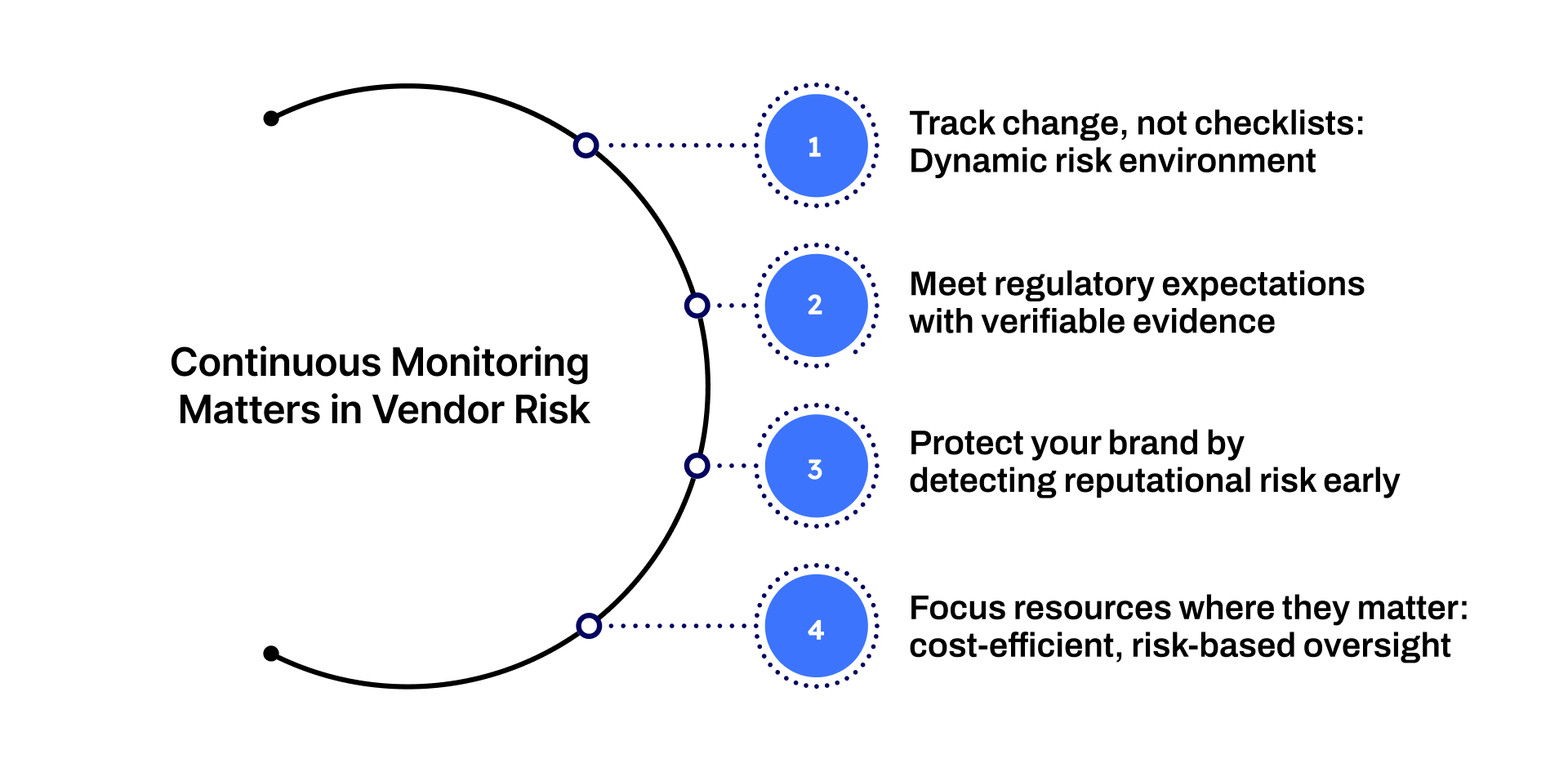
1. Track change, not checklists: Dynamic risk environment
Vendors’ risk profiles shift constantly. A single assessment can't capture incidents that surface months later. Continuous monitoring for vendor risk management provides early visibility into events such as security breaches, operational disruptions, or policy deviations, enabling you to intervene before they escalate.
Actionable points:
Monitor security incidents, certificate expiries, and external disclosures in real time.
Prioritize alerts based on business impact and data exposure.
Automate triage to focus on high-impact risks first.
2. Meet regulatory expectations with verifiable evidence (GLBA example)
Regulators expect ongoing oversight, not annual check-ins. Under GLBA, high-risk vendors require structured and continuous tracking. Monitoring programs create a reliable evidence trail, reducing the chance of missed obligations and regulatory exposure.
Actionable points:
Maintain timestamped records of vendor checks and incident responses.
Define monitoring frequency and triggers by vendor tier.
Map evidence directly to regulatory requirements for faster audits.
3. Protect your brand by detecting reputational risk early
Vendor failures quickly become your headline. Continuous monitoring helps you catch early indicators, breach reports, public disputes, service outages, so you can reassess relationships and respond before stakeholders are affected.
Actionable points:
Track news mentions, legal notices, and industry alerts tied to vendors.
Build rapid-response playbooks for incident handling and communication.
Score vendors on reputational indicators alongside security and operational controls.
4. Focus resources where they matter: cost-efficient, risk-based oversight
Not every vendor needs the same level of attention. A risk-based approach makes continuous monitoring scalable and cost-effective by concentrating efforts on vendors that present the highest exposure.
Actionable points:
Categorize vendors by criticality and data sensitivity.
Use automated health checks for lower-risk vendors.
Measure program impact using time-to-detect and time-to-remediate metrics.
Continuous monitoring turns vendor oversight from an annual task into ongoing protection, faster detection, more unmistakable evidence, and more innovative use of resources.
Also read: The Importance of Continuous Monitoring in Risk Management
Continuous Monitoring Best Practices for Vendor Risk Management
Continuous monitoring for vendor risk management keeps you informed of vendor risks as they occur, not months later. It’s the fastest way to prevent minor vendor issues from growing into business-level incidents.
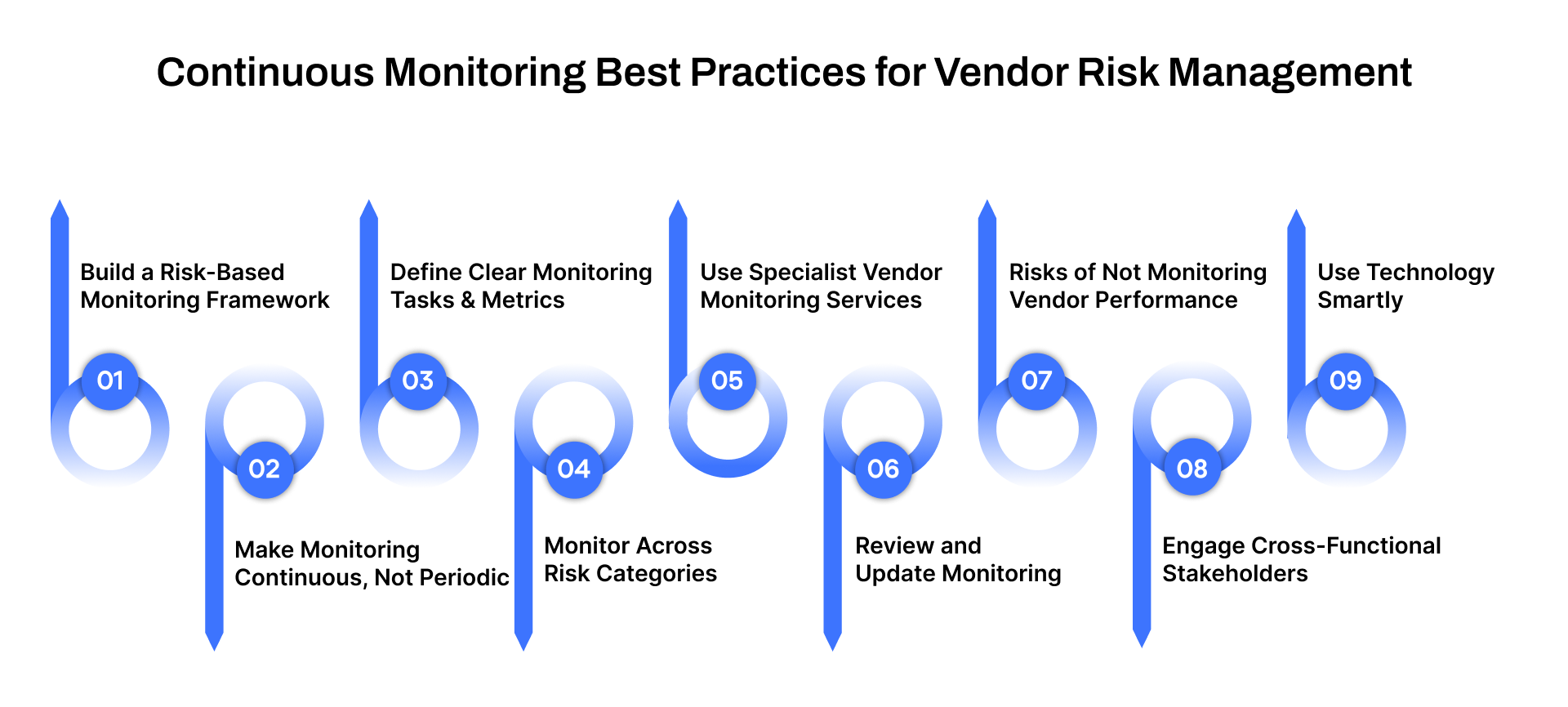
1. Build a Risk-Based Monitoring Framework
A strong monitoring program starts with knowing where risk actually lives. Treat every vendor according to their potential impact, not their contract value or the length of your relationship.
What makes this approach powerful is the precision it creates:
High-risk vendors (handling sensitive data, customer information, or critical operations) get real-time oversight.
Medium-risk vendors move to scheduled performance and security reviews.
Low-risk vendors receive lightweight assessments and automated checks.
The outcome?
Your team avoids drowning in unnecessary work while ensuring the riskiest vendors never fall below the radar.
2. Make Monitoring Continuous, Not Periodic
Quarterly or annual reviews can only tell you what happened months ago. Continuous monitoring closes that gap by surfacing risk signals the moment they appear.
Useful signals include:
Sudden financial deterioration
News of lawsuits, regulatory investigations, or leadership changes
Security incidents or threat-intelligence indicators
Downtime spikes or service degradation
Real value comes from speed, catching a problem while it’s forming, not after it becomes an incident your customers feel.
3. Define Clear Monitoring Tasks & Metrics
Continuous monitoring is only effective when you know what you’re watching and what triggers action.
Make your metrics unambiguous:
Financial: liquidity drops, negative cash flow, credit rating changes
Performance: breach of SLAs, backlogs, missed delivery KPIs
Security: expiring certificates, failed audits, increased vulnerability findings
Privacy: unusual data access patterns, unapproved processors, policy drift
Tie each metric to:
A threshold
An owner
An escalation workflow
This turns your monitoring program into a repeatable system rather than a set of ad hoc checks.
4. Monitor Across Risk Categories
Most vendor failures don't come from a single point of weakness, they come from gaps across multiple domains.
A complete program monitors:
Operational risk: supply chain instability, labor shortages, facility disruptions
Security risk: misconfigurations, phishing incidents, missing patches
Privacy risk: improper data retention, unauthorized data transfers
Reputational risk: lawsuits, negative press, customer disputes
When these domains are monitored in parallel, you uncover early signals that a vendor is drifting off track long before an incident hits your environment.
5. Use Specialist Vendor Monitoring Services When Appropriate
Even well-resourced teams can't manually scan global news, regulatory updates, cyber alerts, financial disclosures, and operational signals.
Specialized tools and services help you:
Automate evidence collection
Correlate risk data from multiple sources
Generate alerts the moment vendor posture changes
Reduce manual monitoring noise
You save time, cut repetitive tasks, and get deeper visibility, especially for high-risk or hard-to-evaluate vendors.
6. Review and Update Monitoring Practices Regularly
A static monitoring framework becomes obsolete fast.
Regular reviews help you strengthen the program by analyzing:
Which alerts mattered
Which signals were noisy
Which vendors changed the critical risk posture
New regulatory or security requirements
Internal feedback from IT, procurement, and security teams
This ensures your monitoring remains relevant, responsive, and aligned with the current threat landscape.
7. Understand the Risks of Not Monitoring Vendor Performance
A vendor can deteriorate quickly, financially, operationally, or in security posture, without giving any visible signs until the damage is already done.
Common consequences of poor monitoring include:
Data breaches caused by outdated security practices
Service outages that disrupt your operations
Reputational loss tied to vendor misconduct
Regulatory exposure due to mishandled customer data
Highlighting these risks helps build internal momentum and reinforces why continuous monitoring is not optional.
8. Engage Cross-Functional Stakeholders
Vendor risk is never owned by one department.
Your monitoring model becomes significantly more effective when procurement, security, legal, IT, privacy, and business teams collaborate.
Shared involvement ensures:
Risk signals don't get lost
Escalation pathways are clear
Contracts and monitoring requirements stay aligned
Remediation is faster and more coordinated
This alignment removes ambiguities and makes vendor oversight a repeatable, organization-wide discipline.
9. Use Technology Smartly (AI/ML Where It Actually Adds Value)
Technology amplifies your monitoring without adding manual load:
AI models identify unusual patterns or risk spikes in vendor behavior
ML classifiers flag anomalies faster than manual review
Automated workflows collect documents, screen vendors, and update profiles
Dashboards provide a real-time view of vendor posture
Tech doesn't replace judgment, it sharpens it by giving your team cleaner, real-time data to act on.
A mature continuous monitoring program doesn't just detect vendor risk, it predicts it, prioritizes it, and helps teams resolve it before it impacts the business.
What a High-Performing Vendor Risk Monitoring Solution Really Delivers
When evaluating platforms, organizations often compare dashboards, scorecards, or reporting templates. But the real differentiator is how well a solution supports continuous monitoring for vendor risk management, not just during onboarding, but throughout the vendor lifecycle. Below is a deeper breakdown of capabilities that actually matter in day-to-day operations.
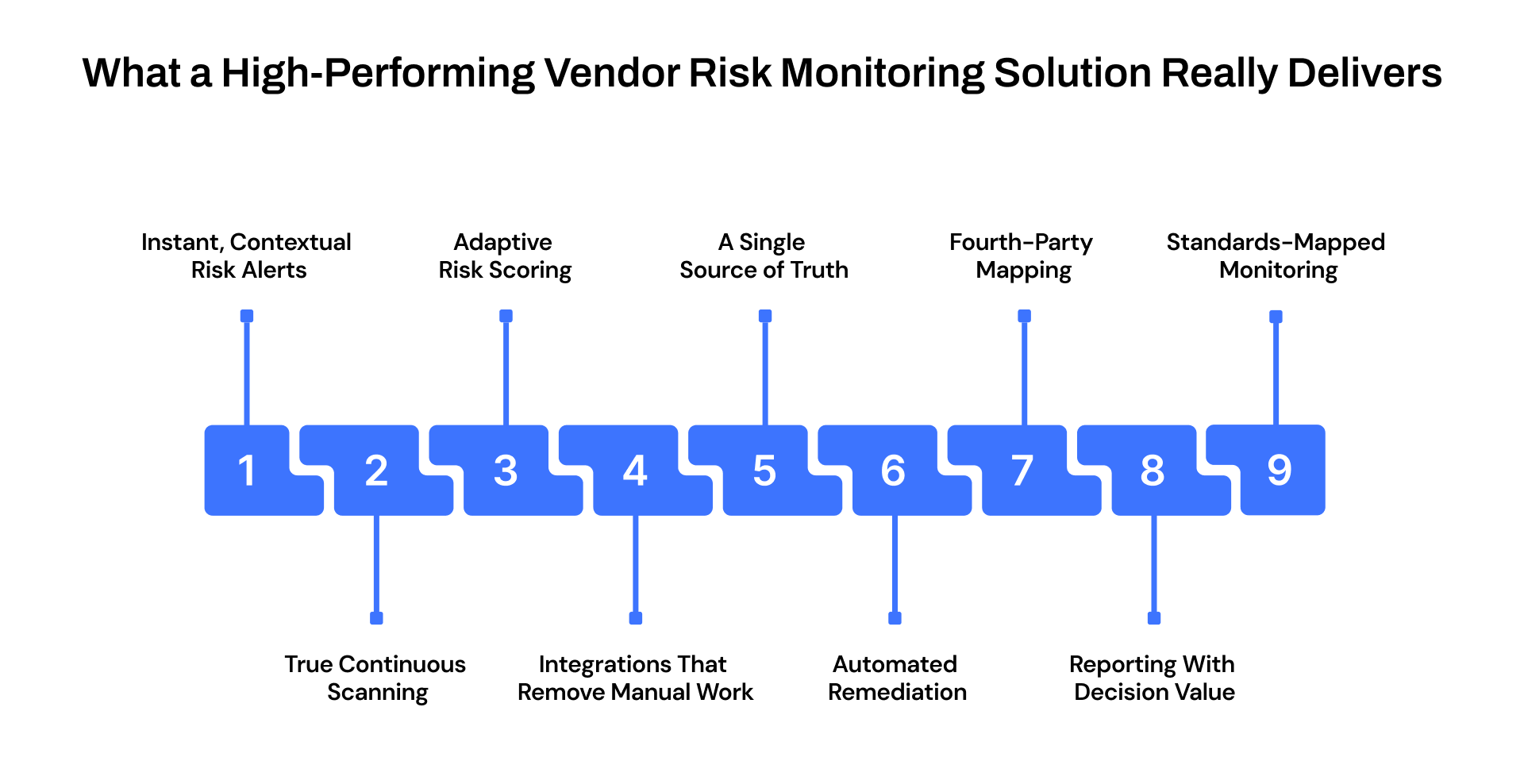
1. Instant, Contextual Risk Alerts: “Act before impact”
A credible solution must detect material changes and notify your team immediately, not bury the signal under noise. Effective alerting should include:
sudden drops in a vendor’s security rating
exposure of new breached credentials or leaked data
infrastructure changes indicating increased attack surface
shifts in domain, certificate, or DNS hygiene
confirmation of new high-severity vulnerabilities
What sets a mature platform apart is context, alerts that explain why the change matters and what you must do next. This saves teams from wasting cycles on false positives and fragmented signals.
2. True Continuous Scanning: “No reliance on periodic reviews”
Ongoing scanning is the backbone of every modern vendor risk program. A strong solution performs near-real-time checks of every vendor’s internet-facing footprint, monitoring for:
expired/misconfigured SSL or TLS
missing HSTS and insecure HTTP settings
vulnerable ports and exposed protocols
weak email-security configurations (SPF, DKIM, DMARC)
newly published CVEs linked to vendor infrastructure
inconsistent configurations that suggest drift
By comparing new scan results with previously validated states, the platform highlights subtle deviations that often precede major incidents. This eliminates dependency on quarterly or annual reviews that miss live risks.
3. Adaptive Risk Scoring: “A score that evolves with the vendor”
Risk scoring should not be static. It must update automatically, using real telemetry to reflect a vendor’s actual posture. A reliable platform provides:
daily (or faster) score refresh cycles
severity-weighted scoring based on asset importance
transparency across categories such as:
network hygiene
DNS hygiene
cloud configuration posture
breach/leak indicators
domain reputation
historical score trends for pattern analysis
This granularity helps teams distinguish between vendors who are temporarily noisy vs. vendors who present systemic risk.
4. Integrations That Remove Manual Work: “Risk workflows where your teams already operate”
A monitoring solution becomes exponentially more useful when it connects to the systems teams rely on daily. Look for:
automated ticket creation in Jira, ServiceNow, or similar tools
audit trails syncing directly to your internal GRC platform
real-time event distribution to Slack, Teams, or SIEM
seamless data exchange via APIs for custom workflows
With these integrations, risk signals turn into assigned, trackable, and measurable actions, not static dashboard items.
5. A Single Source of Truth: “Every vendor, every record, zero digging”
Centralization matters. The platform should maintain a clean, permission-controlled record of:
historical evidence submissions
vendor tier classification and justification
risk waivers, modifications, and expiry
remediation activity and verification steps
communication records for audit readiness
This ensures your team never chases old spreadsheets, emails, or outdated vendor documents.
6. Automated Remediation: “From detection to closure, end-to-end”
Modern TPRM programs increasingly depend on automated remediation workflows. A robust platform should:
generate detailed remediation tickets instantly
include severity, asset location, and recommended fixes
assign owners based on policy-defined SLAs
notify stakeholders automatically
track completion and close tickets once verified
This closes the loop between identification and resolution, something most organizations struggle with.
7. Fourth-Party Mapping: “See the hidden supply chain”
A vendor’s risk posture is often influenced by its own vendors. A capable solution should:
discover embedded technologies and service dependencies
map the indirect supply chain across categories
flag when a fourth-party is breached or exposed
highlight concentration risks across shared tools
This visibility reduces blind spots that questionnaires alone will never uncover.
Also read: Supply Chain Risk Management Strategies and Examples
8. Reporting With Decision Value: “Built for executives, not analysts only”
Reporting is not about volume; it’s about clarity. Look for a platform that generates:
crisp board-level summaries focused on exposure, trending issues, and business impact
in-depth vendor risk profiles with active remediation history
regulatory mapping insights (e.g., where a vendor breaks a required control)
supply-chain impact assessments for procurement and leadership
This ensures leadership understands risk, urgency, and business implications, not just technical findings.
9. Standards-Mapped Monitoring: “Continuous checks mapped to the controls you rely on”
A strong platform must connect daily findings with your internal frameworks such as ISO 27001, GDPR, or PCI. This should include:
mapping expired certificates to specific control failures
identifying policy misalignments in vendor security programs
surfacing findings that affect regulatory readiness
This helps teams measure vendors using the same lens they use for internal risk management.
If you want continuous monitoring for vendor risk management implemented without added process overhead, Auditive combines automated, continuous scans, dynamic trust profiles, and seamless integrations to turn live vendor signals into prioritized, auditable actions your teams can execute immediately.
Continuous Guardrails: How Continuous Monitoring Safeguards Vendor Relationships
Continuous monitoring for vendor risk management isn’t about ticking boxes. It’s about turning signals into action before they become disruptions. When done well, it consistently strengthens vendor oversight across three practical areas.
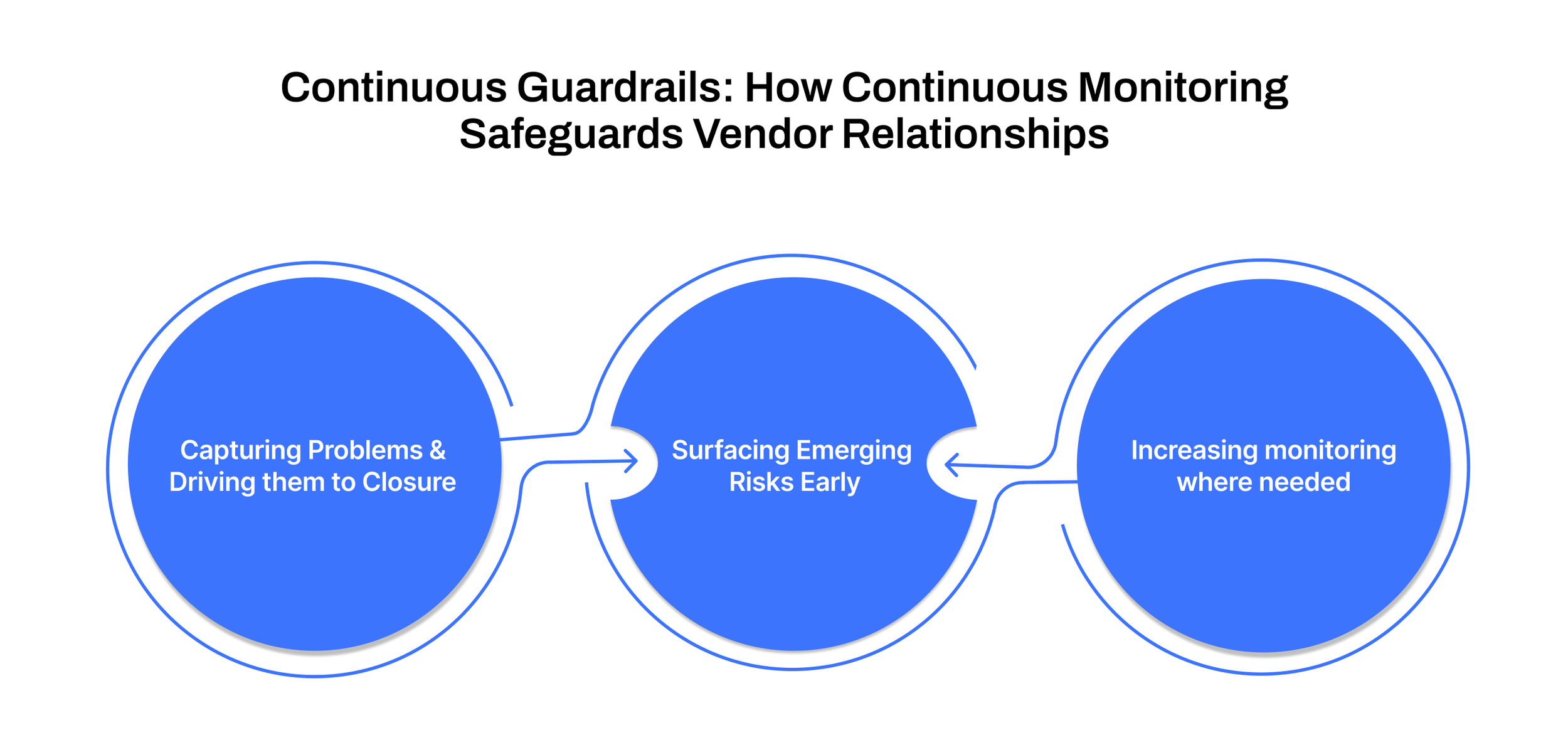
1) Capturing problems and driving them to closure
As soon as an issue appears, log it formally with a clear description, root cause, assigned owner, remediation plan, and target dates. Track every item until closure, and escalate anything that becomes high-risk or overdue so leadership can unlock resources and accelerate resolution. This keeps problem areas contained instead of allowing them to spread.
2) Surfacing emerging risks early
Continuous monitoring helps detect subtle shifts that often precede major disruptions, changes in ownership, weakening financial health, or new regulatory requirements. When these indicators surface, engage the vendor, collect supporting documentation, validate plans, and expand assessments where necessary.
3) Increasing monitoring where needed
Once an issue or emerging risk is identified, increase the intensity and frequency of review. Problems rarely appear in isolation, and a higher monitoring cadence helps uncover related weaknesses before they escalate. This adaptive approach keeps you ahead of potential failures rather than reacting after the damage is done.
Auditive strengthens this entire workflow by converting continuous vendor signals into prioritized actions. Its real-time alerts, dynamic trust profiles, and automated evidence collection help teams validate issues faster and maintain clear visibility into changing vendor conditions, without manual chasing or guesswork.

Auditive’s Approach to Continuous Monitoring for Vendor Risk
Auditive makes continuous monitoring meaningful by tracking real-time changes across your third- and nth-party ecosystem and turning those signals into clear, actionable steps. Its platform updates each vendor’s trust profile automatically, surfaces posture changes as they happen, and eliminates the manual effort of chasing evidence or updates.
With automated workflows and instant alerts, teams can respond to issues faster, validate risks in context, and maintain visibility without relying on periodic reviews.
Auditive essentially closes the gap between detection and action, giving you continuous oversight, reliable intelligence, and a workflow that stays ahead of vendor risk rather than reacting to it.
Wrapping Up
Continuous monitoring only creates value when it helps you act at the right time. The real advantage isn’t in collecting signals but in understanding which ones matter and closing risk gaps before they affect operations. A risk-aware vendor ecosystem relies on visibility, consistency, and the ability to adjust monitoring depth as conditions change, not once a year, but continuously.
If your team wants to replace scattered checks and manual follow-ups with a system that delivers real-time insights, structured issue management, and always-current vendor profiles, platforms built for dynamic monitoring can redefine how you manage vendors end-to-end.
Schedule a demo with Auditive to understand how intelligent monitoring, automated evidence collection, and living trust profiles can give you earlier detection, cleaner workflows, and a stronger vendor risk posture.
FAQs
1. What is continuous monitoring in vendor risk management?
It’s the ongoing evaluation of vendor activity, performance, and risk signals to detect issues or emerging threats as they occur, not during infrequent assessments.
2. Why is continuous monitoring necessary?
Vendor conditions change often. Continuous monitoring helps catch early indicators such as control gaps, operational changes, financial instability, and security concerns.
3. How does continuous monitoring differ from periodic reviews?
Periodic reviews offer a static snapshot. Continuous monitoring provides real-time updates that reflect a vendor’s current risk posture.
4. When should monitoring frequency be increased?
Anytime an issue is logged, an emerging risk appears, or a vendor shows inconsistent behavior that could indicate broader weaknesses.
5. How does Auditive support continuous vendor monitoring?
Auditive tracks vendor changes in real time, updates trust profiles automatically, and turns monitoring data into prioritized actions, reducing manual work and strengthening overall vendor oversight.
