
How to Implement a Vendor Risk Management Program
Just 13% of companies continuously monitor the security risks of their third-party vendors, according to a recent report. That means even though most organizations recognize vendor risk as a real problem, only a handful truly act on it.
Implementing a structured VRM program changes that. By defining what risk means to you, categorizing your vendors effectively, and applying ongoing, signal-based monitoring, you build a system that doesn’t just react; it prevents and adapts.
In this blog, we’ll walk through how to create a VRM program from scratch, one that helps your security and procurement teams stay ahead of real risk.
Core takeaways:
A strong VRM program provides ongoing visibility into vendor-related risks.
A strategy keeps vendor controls, evidence, and communication in one place.
Continuous monitoring helps prevent high-impact disruptions.
Auditive brings structure, automation, and assurance to your vendor oversight.
With a centralized and intelligent VRM workflow, decisions become faster and more defensible.

What Is a Vendor Risk Management (VRM) Program?
A VRM program in 2025 is a structured way for organizations to identify, assess, and control risks introduced by third-party vendors. As companies rely on external providers for cloud hosting, SaaS tools, data handling, and critical operational services, the attack surface grows, and so does the potential impact of a single vendor failure.

Recent data shows how quickly third-party exposure is accelerating.
Third-Party Breach Report: 35.5% of data breaches involved a vendor, marking a steady increase over the past three years.
This pattern reflects a clear shift: incidents tied to vendors are no longer rare exceptions; they’re becoming a consistent part of enterprise risk.
A modern VRM program goes beyond one-time questionnaires or yearly check-ins. It requires:
AI-supported risk evaluations that analyze vendor security posture using actual evidence rather than guesswork.
Automated control tracking to replace static spreadsheets with real-time updates on policy gaps, overdue documents, and expired certifications.
Continuous security monitoring that alerts teams when a vendor’s risk posture changes, whether due to a new vulnerability, breach incident, or failing control.
Full-lifecycle oversight, covering onboarding, active monitoring, and offboarding, ensuring no stage introduces silent risks.
In 2025, building a VRM program means treating vendor oversight as a daily practice, not an annual checkbox exercise. Organizations that respond quickly to changes in vendor posture limit the blast radius of third-party failures and protect both their data and operations.
Also read: Effective Continuous Risk Monitoring Practices and Techniques
Why a VRM Program Matters More Than Ever
Third-party vendors introduce risks that can bypass even strong internal controls. A VRM program provides a structured way to evaluate and manage those risks before they turn into operational or security failures.
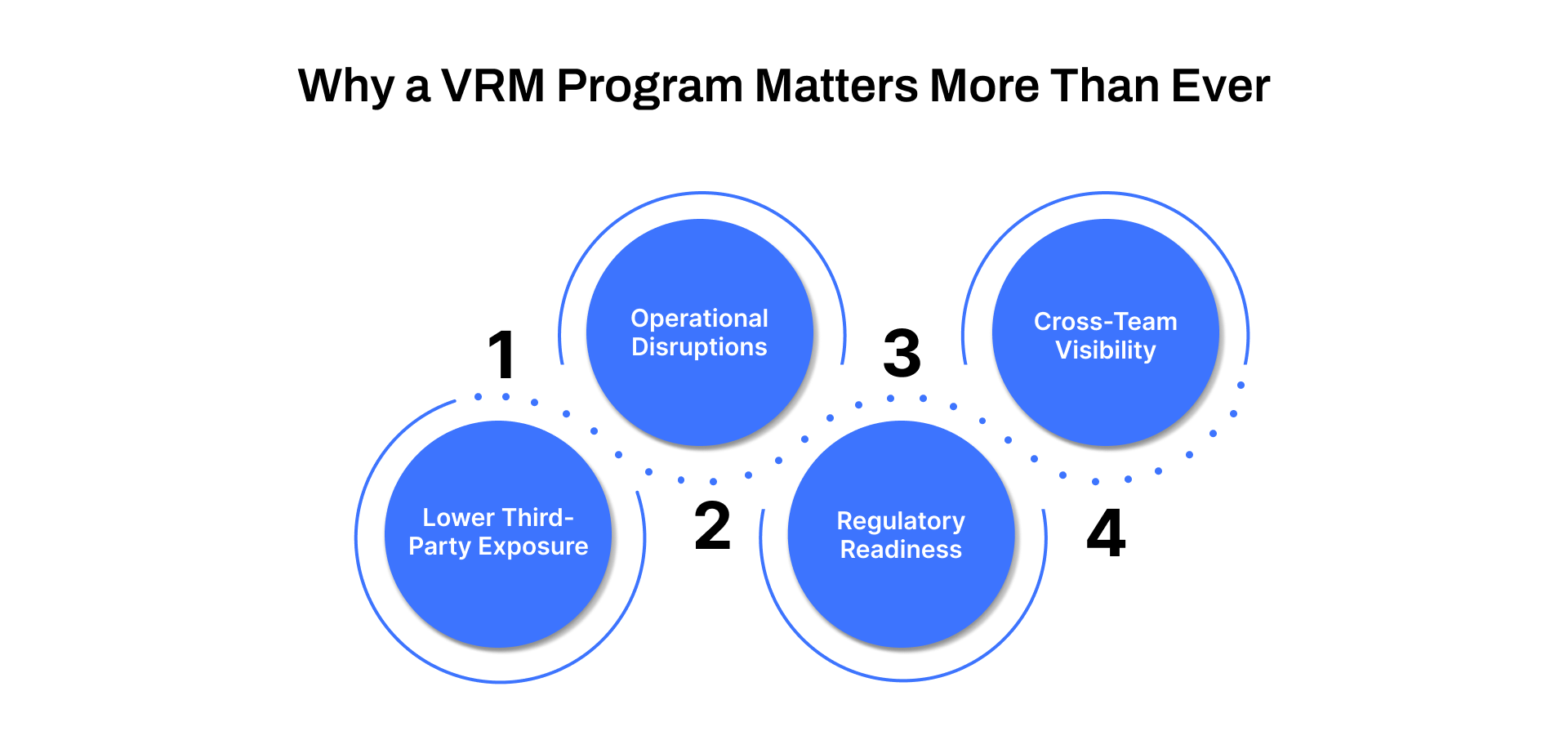
What a Strong VRM Program Delivers
Lower third-party exposure: Consistent assessments reduce hidden risks during onboarding and ongoing engagement.
Fewer operational disruptions: Clear ownership prevents missed steps that often lead to vendor-driven incidents.
Regulatory readiness: Built-in due diligence supports faster, evidence-based vendor approval or remediation.
Cross-team visibility: Centralized vendor risk data helps leadership understand ecosystem-wide impact.
A VRM program isn’t just a safeguard; it defines how vendors enter, operate within, and affect your environment. By aligning assessments, decisions, and monitoring under one framework, organizations gain control over third-party dependencies instead of reacting to them.
How to Implement a VRM Program: A Clear, Practical Breakdown
A VRM program only works when it’s built on structure, repeatability, and a clear understanding of your organization’s risk tolerance. Here’s a straightforward breakdown of how to implement a program that actually supports decision-making and reduces exposure in your vendor ecosystem.
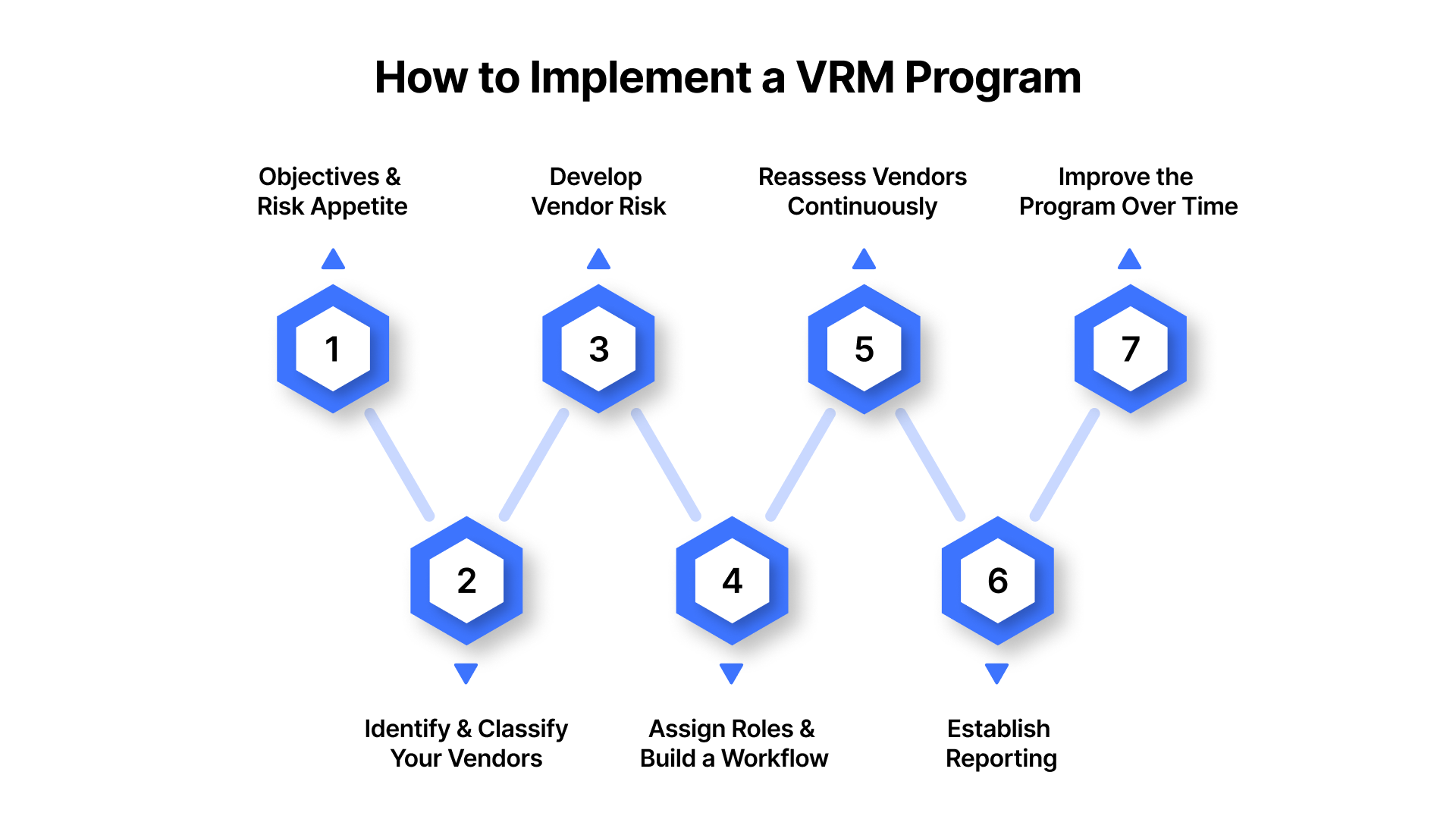
1. Define Objectives and Risk Appetite
A VRM program only works when its purpose is defined upfront.
What to determine:
The exact risks you want to reduce (e.g., data-handling errors, downtime, regulatory exposure).
Whether your priority is preventing outages, protecting customer information, or reducing financial impact.
Your organization’s risk appetite is the threshold of risk your leadership is willing to accept.
Setting direction at this stage ensures your VRM program aligns with measurable goals and realistic tolerance levels.
2. Identify and Classify Your Vendors
You can’t manage risk until you have a complete, verified list of vendors.
What to include in the inventory:
Active vendors across the business.
Shadow IT tools or unmanaged SaaS services.
Contractors or partners with system or data access.
How to classify vendors:
High risk: vendors with critical system access or handling sensitive data.
Medium risk: vendors supporting operational processes.
Low risk: vendors with minimal or no access.
Accurate vendor tiering ensures that assessment depth matches actual exposure.
3. Develop Vendor Risk Assessment Criteria
Each risk tier requires its own assessment standards to avoid over- or under-reviewing vendors.
High-risk vendor requirements may include:
SOC 2 or ISO 27001 reports
Penetration testing summaries
DPAs and data-flow documentation
Medium- and low-risk vendors may only need:
Policy confirmations
Basic security statements
Limited supporting evidence
Closing this step with tier-specific criteria avoids unnecessary complexity while ensuring high-impact vendors receive proper scrutiny.
4. Assign Roles and Build a Workflow
A Vendor risk management program must operate through clear ownership across functions.
Typical role distribution:
Procurement: flags new vendors and initiates intake.
Security/IT: performs technical evaluations.
Legal: verifies contract clauses and data terms.
Risk/GRC: approves final decisions and tracks remediation.
Key workflow elements:
Intake process
Assessment timeline
Documentation requirements
Approval paths
Remediation steps
A defined workflow ensures vendors move through the program consistently and without delays.
5. Monitor and Reassess Vendors Continuously
Risk profiles shift over time, so ongoing visibility is essential.
What to monitor:
Breach disclosures and incident reports
Expired certifications
Financial instability
Operational disruptions or M&A changes
Negative press coverage
Review frequency by tier:
High risk: every 6–12 months
Medium risk: annually
Low risk: during renewal cycles
Closing the loop with continuous monitoring prevents outdated or inaccurate vendor risk assumptions.
6. Establish Reporting and Escalation Protocols
Measuring performance keeps the VRM program accountable.
Useful KPIs include:
Percentage of high-risk vendors assessed
Average time to complete reviews
Number of risks remediated per vendor
Escalation should address:
Who decides when a vendor needs remediation
When an exception is allowed
When a vendor relationship should pause or terminate
Clear reporting and escalation paths enable consistent decisions across teams.
7. Improve the Program Over Time
A VRM program should evolve alongside your vendor ecosystem.
What to update regularly:
Assessment templates, based on new incidents or controls
Evidence requirements for high-risk vendors
Internal workflows, based on bottlenecks
Integrations with GRC or security tools
Continuous refinement ensures the VRM program moves toward proactive, rather than reactive, vendor oversight.
When you build a VRM program, defining workflows and collecting evidence are essential, but they quickly become cumbersome as vendor count grows. Auditive’s AuditiveX network provides continuous 365-day monitoring and live incident reporting for all your vendors.
Learn more about:How to Conduct a Comprehensive Security Risk Assessment?
How Auditive Strengthens a VRM Program
Most VRM programs fail not because the framework is wrong, but because vendor information goes stale the moment assessments are completed. Auditive solves this by keeping vendor data alive, current, and connected to the people who need it.
What this looks like in practice:
Risk teams stay ahead of changes, not behind them. AuditiveX monitors vendors year-round and flags shifts that matter, an expired SOC 2, a new incident, or gaps that appear after a control update. Teams see issues as they occur, instead of discovering them during an annual review.
Vendors update their own information, so teams don’t chase documents. Through the Trust Exchange, vendors maintain a single Trust Profile. When they upload new evidence, every connected customer sees the update automatically.
Assessments aren’t repetitive. Auditive maps vendor evidence to required controls and highlights only what’s missing. This removes the back-and-forth emails and keeps the conversation focused on real risk.
Every team works from the same source of truth. Legal, procurement, risk, and security teams can assign tasks, approve decisions, and track remediation in one workflow, without relying on manual reminders.
Integrations reduce double work. With 100+ supported APIs, updates flow into systems teams already use, like JIRA or Salesforce, so no one has to re-enter vendor data.
Auditive supports VRM programs by giving teams the one thing they rarely have: verifiable vendor information that updates itself.
Wrapping Up
A well-structured vendor risk management program does more than keep third-party risks in check; it builds operational confidence. As your vendor network expands, the ability to monitor what suppliers access, how they operate, and where vulnerabilities emerge becomes a foundational part of maintaining trust within your organization.
Auditive centralizes visibility, simplifies oversight, and keeps your teams aligned on every vendor-related decision, turning VRM from a routine control into a strategic advantage.
If you want a system that doesn’t just store vendor data but actively strengthens your security posture, Auditive helps you move from reactive to assured. You can manage every vendor with clarity, evidence, and continuous risk-based intelligence.
Schedule a demo with the Auditive team and explore how a purpose-built strategy elevates your vendor ecosystem.
FAQs
1. Why is a VRM program necessary?
Because vendors directly influence your operational, security, and compliance posture. A VRM program ensures their risks are identified, evaluated, and controlled.
2. What does Auditive do in vendor management?
It centralizes vendor information, risk scores, documents, policies, and ongoing assessments, making review and decision-making clearer and faster.
3. How often should vendor risks be reassessed?
This varies by criticality. High-risk vendors require continuous or quarterly reviews, while low-risk vendors may need annual evaluations.
4. What information should be collected during vendor onboarding?
Security controls, certifications, policies, financial stability, data-handling practices, integrations, and operational dependencies.
5. How does Auditive support VRM programs?
Auditive automates assessments, provides a central approach, tracks risks in real time, and gives teams one structured place to review vendor evidence and decisions.
