
Top Supply Chain and Risk Management Conferences 2026

The supply chain is entering a period where disruption is no longer occasional; it’s constant, fast, and shaped by technologies that shift week to week. That’s why every supply chain risk management conference in 2026 is expected to focus less on theory and more on the operational changes organizations must make as automation, AI-led forecasting, and real-time visibility tools become the new baseline.
As industries prepare for tighter delivery cycles, digital-first operations, and vendor ecosystems that function as extensions of internal teams, leaders are looking for clarity on what the next evolution actually means in practice.
This blog breaks down what’s ahead for the supply chain world in 2026, how technology will reshape decision-making, and where organizations should prioritize investments to stay resilient.
Key Takeaways
In 2026, supply chains will rely heavily on AI-supported forecasting and automated decision-making cycles.
Real-time monitoring and telemetry will become essential for vendor and third-party visibility.
Sustainability, cyber resilience, and operational agility will drive procurement decisions.
Vendor signals will matter more than ever as systems become more interconnected.
Continuous oversight tools like Auditive help teams stay ahead of rapid ecosystem shifts

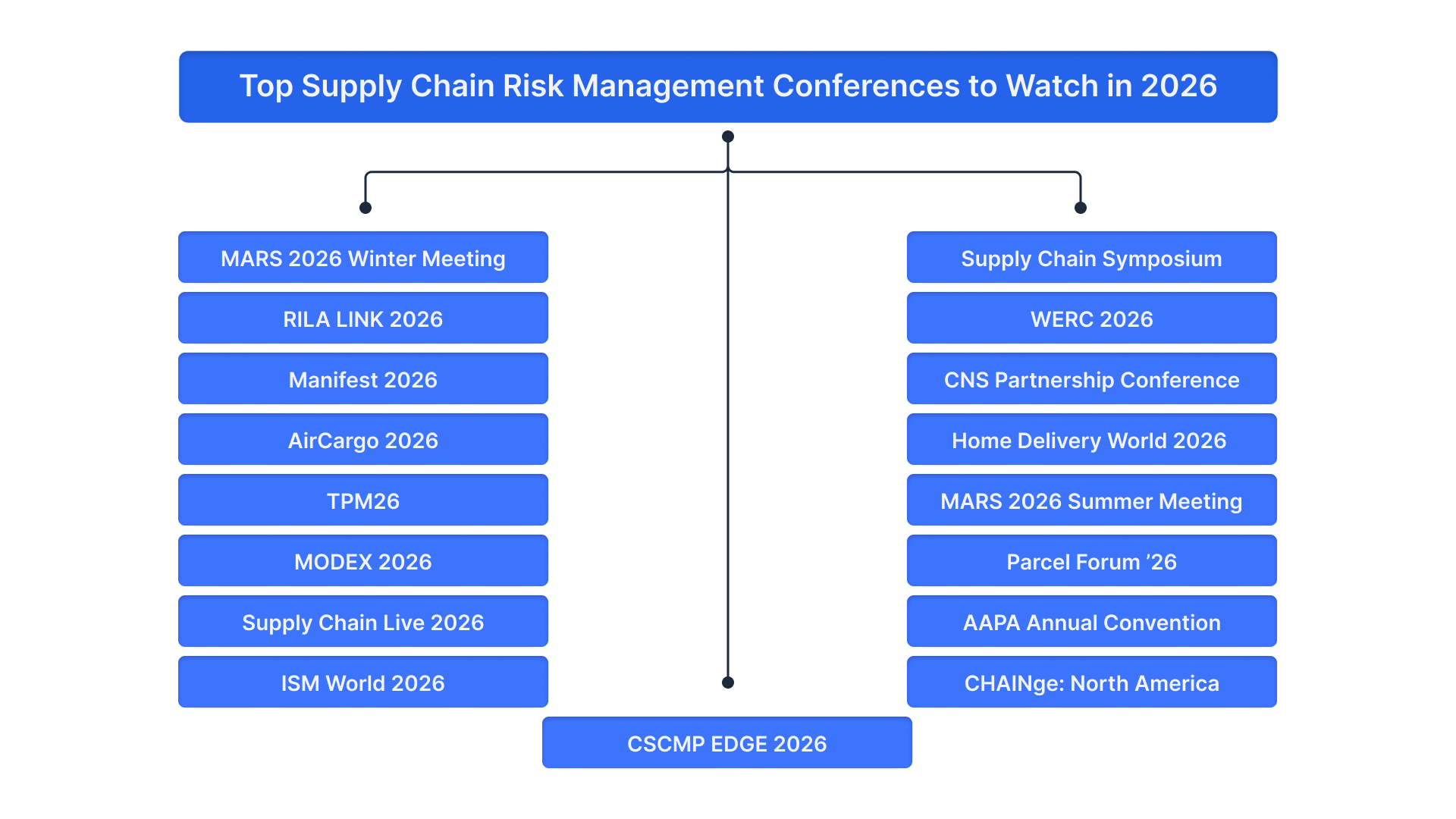
Top Supply Chain Risk Management Conferences to Watch in 2026
Staying ahead in supply chain risk management means knowing where the real conversations, innovations, and industry shifts are taking place. Each conference in this list serves a different purpose that actually moves the industry.
Instead of offering another predictable list, this guide breaks down what truly sets each event apart, so you can pick the ones that match your priorities, budget, and role in the supply chain ecosystem.
Must Read: Benefits of Supply Chain Risk Management Strategies
MARS 2026 Winter Meeting
Jan 13–15 | Schaumburg, Illinois
MARS stands out because it’s one of the few events that focuses purely on rail-dependent supply chains. Instead of high-level theory, attendees get direct updates from carriers, regulators, and shippers on network performance, disruptions, and rate trends.
Choose this if: You rely heavily on North American rail and want a grounded, operations-first view of capacity, congestion, and service outlooks.
RILA LINK 2026
Feb 1–4 | Orlando, Florida
LINK is built specifically for retail, grocery, and consumer-product supply chains, making it the closest you’ll get to a fully retail-aligned operating forum. The differentiator: C-suite to rising-star integration. Retail leaders share how they’re redesigning networks for speed, omnichannel readiness, and SKU complexity.
Choose this if: You want retail benchmarks, real-world fulfillment strategies, and decision-maker access in one place.
Manifest 2026
Feb 9–11 | Las Vegas, Nevada
Unlike most tech-forward events, Manifest succeeds because it blends Fortune 500 operators with emerging logistics technology. More than 400 speakers, from Maersk, Ikea, Walmart, and Foot Locker, break down automation adoption, robotics ROI, and AI-enabled planning.
Choose this if: You’re evaluating logistics tech and want proof-of-value, not sales pitches.
AirCargo 2026
Feb 15–17 | Orlando, Florida
AirCargo brings together all the air-freight stakeholders under one roof: carriers, airports, forwarders, GSPs, regulators, and tech vendors. The real advantage is its focus on disruption response, capacity swings, regulatory changes, security requirements, and global network volatility.
Choose this if: Air cargo is a major dependency and you need clear visibility into risks, constraints, and future lanes.
TPM26
Mar 1–4 | Long Beach, California
TPM is where shippers go when they need complex data on freight rates, tariffs, carrier performance, and global trade volatility. It’s run by the Journal of Commerce (S&P Global), so the content is deeply analytical, no fluff.
Choose this if: Ocean shipping is your biggest exposure and you need insights that actually shift your contracting strategy.
MODEX 2026
Apr 13–17 | Atlanta, Georgia
MODEX is unique because it’s not just a conference; it’s a massive live product demo floor. Robotics, automation, AMRs, WMS systems, and material handling tools are showcased with real workflows, not mockups. With 50,000 buyers, it’s the place vendors launch serious tech.
Choose this if: You want to evaluate warehouse automation in person before making big capital decisions.
Procurement & Supply Chain Live 2026
Apr 22–23 | Chicago, Illinois
This event shines in areas most conferences overlook: procurement value, sustainability strategy, supplier performance, and digital procurement maturity. It’s built around 20 content tracks and eight executive workshops, giving leaders practical playbooks rather than generic panels.
Choose this if: You manage suppliers, categories, or sourcing risk and need tactical guidance, not high-level trends.
ISM World 2026
Apr 26–28 | Denver, Colorado
ISM World is designed for skill-building. Workshops and sessions dive into contracting, negotiations, risk assessment, supplier development, and cost modeling. It’s the best event for teams wanting to strengthen core procurement capabilities.
Choose this if: You need a hands-on learning environment rather than a networking-first event.
Gartner Supply Chain Symposium 2026
May 4–6 | Orlando, Florida
This is the conference for leadership teams making big decisions: network redesign, resilience investments, AI adoption, and talent transformation. Gartner’s advantage is its research-led guidance, frameworks, maturity models, and benchmark data.
Choose this if: You’re shaping long-term supply chain strategy and need validated models, not opinions.
WERC 2026
May 17–20 | Jacksonville, Florida
WERC is the most practical event for warehouse operators. Sessions unpack DC design, productivity, labor models, engineering, automation fit, and day-to-day operational issues.
Choose this if: You run fulfillment or DC operations and want proven methods to boost throughput and cut waste.
CNS Partnership Conference
May 18–20 | San Francisco, California
Hosted by IATA, this event attracts the highest concentration of air cargo decision-makers in North America. Discussions center on market access, global capacity planning, airline partnerships, and regulatory alignment.
Choose this if: You want direct access to airline executives, forwarders, and integrators without fluff.
Home Delivery World 2026
May 20–21 | Nashville, Tennessee
If your risk exposure sits in final-mile delivery, HDW is unmatched. It brings together parcel carriers, startups, technology providers, 3PLs, and retailers across 100 sessions.
Choose this if: You're redesigning last-mile operations or exploring delivery automation, parcel optimization, or reverse logistics.
MARS 2026 Summer Meeting
Jul 13–14 | Lake Geneva, Wisconsin
The summer meeting provides mid-year updates on rail service levels, labor changes, equipment availability, and economic outlooks.
Choose this if: You need direct visibility into rail trends between peak planning cycles.
Parcel Forum ’26
Sept 14–16 | Orlando, Florida
Parcel Forum is the most targeted event for small-parcel operations and last-mile performance. It covers carrier negotiations, surcharges, transit-time reliability, and packaging optimization.
Choose this if: You ship high parcel volumes and want data-driven methods to control cost and maintain speed.
AAPA Annual Convention & Expo
Sept 28–30 | New Orleans, Louisiana
AAPA is the hub for port authorities, marine terminals, cargo owners, and waterfront logistics leaders. Sessions focus heavily on port capacity, infrastructure funding, maritime regulations, and global trade flow risks.
Choose this if: Your supply chain relies on seaport performance and global routing stability.
CHAINge: North America
Sept 29–30 | Long Beach, California
Hosted by ASCM, CHAINge dives into talent development, digital transformation, sustainability, and logistics disruption management. Particularly strong on skills, workforce planning, and org structure design.
Choose this if: You’re working on developing supply chain talent or redesigning operational teams.
CSCMP EDGE 2026
Oct 4–7 | Nashville, Tennessee
EDGE stands out for its scale and depth: 100+ sessions, C-suite keynotes, and the highest mix of director-level and above attendees. Content spans network strategy, forecasting, logistics, AI, and sustainability.
Choose this if: You want an all-in-one supply chain education conference at an executive depth.
Also Read: Top Supply Chain Risks and Mitigation Strategies
Supply Chain Risk Management Conferences: Quick Comparison Table
| Conference | Best For | Core Focus | Who Attends | Unique Advantage |
|---|---|---|---|---|
| MARS Winter & Summer Meetings | Rail-focused teams | Rail operations, shipping trends | Rail carriers, shippers | Consistent updates from the North American rail community |
| RILA LINK | Retail supply chains | End-to-end retail logistics | Retail execs, manufacturers | C-suite access + retailer-only insights |
| Manifest | Enterprise-scale innovation | Logistics tech + automation | Fortune 500, VCs, LSPs | Massive tech presence + 400+ speakers |
| AirCargo Conference | Air freight professionals | Air cargo trends & disruptions | Carriers, forwarders, airport leaders | Deep dive into air cargo operational challenges |
| TPM26 | Global ocean shipping | Container shipping + trade policy | Shippers, ocean carriers | Tariff + cost-mitigation strategies |
| MODEX | Procurement & operations teams | Supply chain equipment + automation | Buyers & tech vendors | Hands-on demos of new equipment |
| Procurement & Supply Chain Live | Procurement leads | Sustainability + strategic sourcing | Procurement & SC leaders | Wide agenda + executive workshops |
| ISM World | Supply chain strategists | Vendor mgmt, sourcing, resilience | Directors, managers | Strong educational tracks |
| Gartner Supply Chain Symposium | Senior leadership | Risk, volatility, leadership | Global supply chain leaders | Gartner-backed research + future forecasts |
| WERC | Warehouse teams | Warehousing & DC operations | Ops leaders, tech teams | Best practices for warehouse optimisation |
| CNS Partnership | Air cargo decision-makers | Air freight future outlook | Airline & logistics execs | IATA-led insights |
| Home Delivery World | Last-mile leaders | Final-mile delivery & fulfilment | Delivery startups + enterprise | Largest last-mile innovation event |
| Parcel Forum | Parcel ecosystem | Small-parcel logistics | Retail, shipping, and warehouse teams | Deep focus on parcel networks |
| AAPA Convention | Port & maritime leaders | Port operations & logistics | Port authorities & supply chain execs | Maritime-exclusive perspective |
| CHAINge | Transformation teams | Digital supply chain + resilience | Leaders from major brands | Roundtable-driven conversations |
| CSCMP EDGE | Senior supply chain professionals | Strategy, innovation & global trends | Execs, directors & managers | Gradient of leadership content |
Use these distinctions as a filter to prioritize the events that match your current challenges and long-term plans. A smarter conference schedule means better insights, stronger partnerships, and fewer wasted days away from your operations.
Learn more about: Supply Chain Risk Management Strategies and Examples
What’s Ahead for the Supply Chain in 2026
2026 will push supply chains toward faster automation, real-time visibility, and tighter digital risk controls, the same themes shaping every major supply chain risk management conference next year.
AI agents shift to core decision support. Adoption moves from trials to targeted use cases like forecasting, exception resolution, and inventory balance.
Automation strengthens labor-strained operations. Robotics and autonomous movement take on repetitive warehouse and last-mile work.
Real-time tracking becomes standard, not premium. IoT and ledger-backed traceability improve incident detection and supplier visibility.
Sustainability turns into contract-bound requirements. Electric fleets and supplier emissions reporting become embedded in procurement terms.
Cyber resilience rises sharply. More connected systems mean vulnerabilities travel faster across vendors and logistics partners.
These trends raise the stakes for vendor reliability, not as a procurement issue, but as a direct operational risk.
Auditive gives teams a live view of vendor posture, automatically refreshes evidence, and surfaces meaningful risk signals so supply chain decisions stay reliable as operations become more automated and time-sensitive.
How Auditive Strengthens Supply Chain Risk Visibility
Auditive gives you real-time awareness of supplier risk across your entire supply chain, not just the partners you directly contract with. Its Supply Chain Continuous Monitoring surfaces upstream and downstream incidents the moment they occur, so disruptions never blindside your operations.
The platform tracks issues ranging from security breaches to financial instability and sends instant alerts directly to your inbox. Behind the scenes, AI agents recalculate your exposure in real time, giving you an updated view of impact without manual checks or follow-ups.
This matters because supply chains now depend on layered networks where a single weak link can stall production, delay fulfillment, or affect customer delivery timelines. Auditive closes that visibility gap, helping teams detect early risks, quantify ripple effects, and act before minor incidents escalate.
Straightforward, timely, and built for fast-moving supply-chain environments, Auditive turns monitoring into a continuous advantage.
In Summary
The shifts coming to the supply chain in 2026 aren’t abstract predictions; they directly influence how organizations plan, monitor, and secure their extended networks. As automation, AI-driven forecasting, real-time tracking, and data-heavy operations scale, the weakest point will always be the external partners carrying part of that load. Preparing for next year means tightening visibility, strengthening vendor signals, and ensuring that every link in the chain can keep pace with the technology shaping it.
If you want a system that keeps up with this pace instead of adding more manual checks, Auditive gives you a continuously updated view of vendor posture, risk changes, and third-party activity in one place.
Schedule a demo to see how real-time monitoring supports a more resilient supply chain ecosystem.
FAQs
1. Why is 2026 considered a major turning point for supply chains?
Organizations are moving from experimental automation to operational AI, forcing every part of the supply chain, including vendor oversight, to adapt.
2. Will AI fully replace human decision-making in supply chain operations?
Not fully; AI will support high-volume decisions and exception handling, while humans continue to manage strategic and risk-sensitive calls.
3. How does vendor risk tie into these changes?
As systems become more connected, disruptions or weaknesses in any vendor’s tech, data, or processes ripple through faster, increasing overall exposure.
4. What role does sustainability play in vendor selection for 2026?
Sustainability criteria are becoming part of contractual requirements, meaning vendors must demonstrate clear emissions, sourcing, or operational standards.
5. How can Auditive help teams stay ahead of these shifts?
Auditive provides continuous vendor risk visibility, live posture updates, and automated alerts, reducing the lag between third-party changes and operational decisions.
