
The Ultimate GDPR Vendor Contracts Checklist Every Business Needs

In industries like FinTech, HealthTech, or EdTech, handling large amounts of personal data brings about the need for GDPR vendor contracts to ensure proper compliance with the General Data Protection Regulation (GDPR).
With the growing number of data breaches, customers have become increasingly aware of the need for strong privacy protections. Therefore, if you're responsible for overseeing information, cybersecurity, and technology within your company, understanding how to implement GDPR vendor contract compliance is crucial.
This checklist will guide you through the essential steps to ensure that your vendor contracts meet GDPR standards, helping you mitigate risks and maintain trust with your clients.
Key Takeaways
Identifying and cataloging the personal data you process is the first step in ensuring GDPR compliance in vendor contracts.
Ensure all vendors involved in data processing obtain explicit, informed consent from individuals before collecting or using their data.
Vendor contracts should have clear clauses requiring timely breach notifications, outlining responsibilities for investigation and cooperation with authorities.
Vendors must be obligated to maintain detailed records of processing activities, demonstrating their compliance with GDPR’s accountability principle.
For vendors handling data outside the EU, use SCCs or BCRs to ensure compliance with GDPR’s regulations on international data transfers.
What is GDPR Compliance?
The General Data Protection Regulation (GDPR) is a comprehensive data protection law enacted by the European Union in 2018. It was designed to give individuals more control over their personal data and to streamline data protection regulations across Europe. GDPR has far-reaching implications, affecting organizations that handle personal data, whether they are located in the EU or outside it.
For companies working with third-party vendors, this extends to ensuring that any agreements with vendors that process personal data are legally sound and fully compliant.
Managing GDPR vendor contract compliance can be overwhelming, but with Auditive’s Contract Monitor, you can easily track vendor adherence to GDPR clauses. This tool extracts key contract information, monitors changes in real-time, and sends automated reminders for renewals or upcoming expirations.
Now that you know what GDPR entails, it’s important to clarify who GDPR actually applies to in your vendor network.

Who Does GDPR Apply To?
GDPR extends beyond your own operations; it covers any vendor, subcontractor, or processor that handles EU personal data. The GDPR applies to two main categories of organizations:
Organizations Established in the EU: If your organization is based in the EU, GDPR applies regardless of how frequently you process personal data of EU citizens.
Organizations Outside the EU: If you’re located outside the EU but offer goods or services to EU residents or monitor their behavior, GDPR applies to you too.
This means that even if your organization is outside the EU, GDPR vendor contracts are necessary when collaborating with vendors who may handle personal data of EU residents.
Also Read: Top Cyber Security Risk Assessment Tools of the Year
Once you know who is accountable, it’s easier to appreciate why GDPR compliance benefits you and your vendors.
5 Benefits of GDPR Compliance for Vendors
For businesses handling the complexities of data privacy, adhering to GDPR brings several tangible benefits that go beyond legal requirements. Here are the key advantages of GDPR compliance that can enhance your organization's reputation and operations.
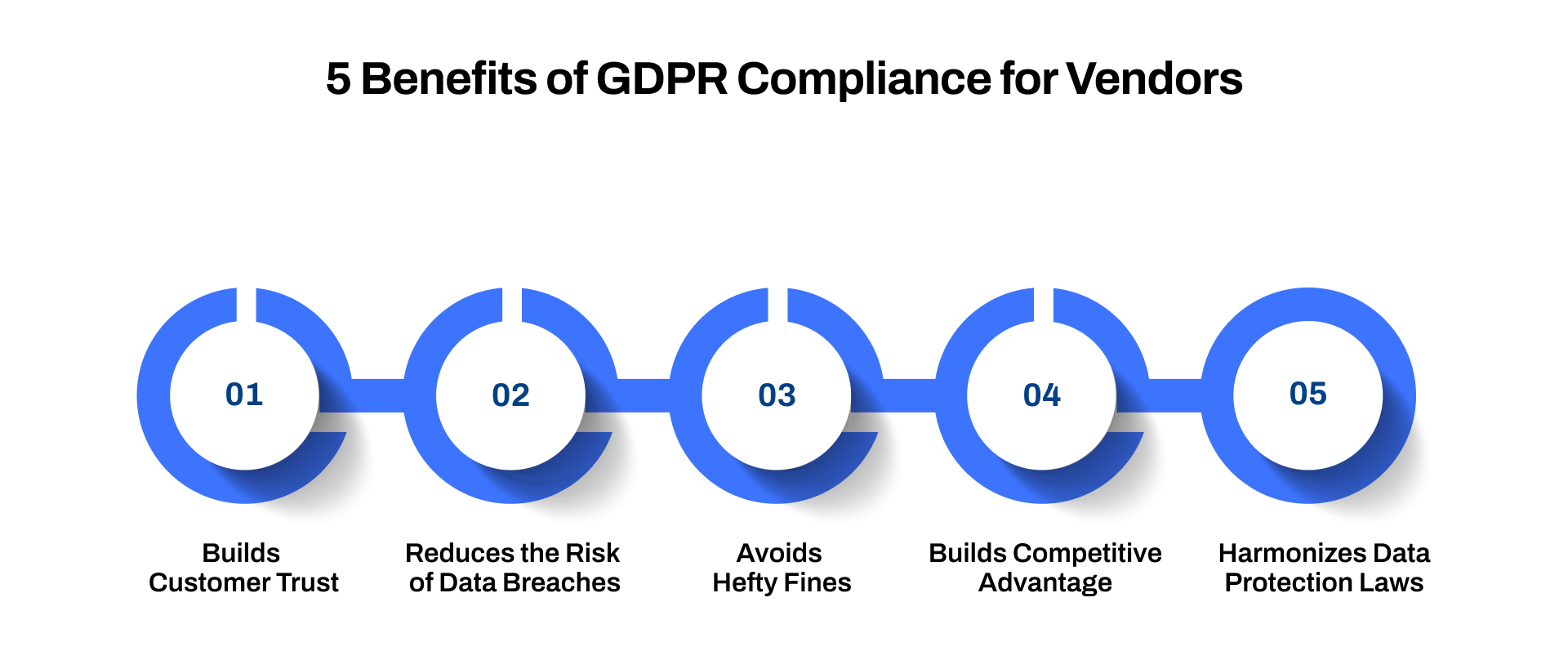
1. Builds Customer Trust by Strengthening Data Privacy
By adhering to GDPR, you show customers that you take data privacy seriously. When customers trust you with their personal information, they’re more likely to engage with your business, improving customer loyalty and satisfaction.
2. Reduces the Risk of Data Breaches
Implementing strong GDPR compliance measures reduces the risk of data breaches. When your vendor contracts include clear data protection obligations, you minimize the risk of security incidents that could damage your brand.
3. Avoids Hefty Fines
One of the key reasons to comply with GDPR is the avoidance of fines. Ensuring your vendor contracts are compliant protects your business from these risks.
4. Builds Competitive Advantage
Companies that comply with GDPR demonstrate their commitment to data protection, which can be a unique selling point. This may give your business a competitive edge, especially in sectors where data security is critical, such as healthcare and financial services.
5. Harmonizes Data Protection Laws
GDPR provides a unified framework for data protection across the EU, streamlining compliance for businesses operating in multiple European countries. This simplifies the legal process for international companies and vendors.
Also Read: Benefits of Supply Chain Risk Management Strategies
After exploring the benefits, let’s get into the GDPR vendor contracts checklist.
Essential GDPR Vendor Contracts Checklist
Vendor contracts are the backbone of GDPR compliance, defining responsibilities, safeguards, and data-handling rules. This checklist ensures your third-party agreements tick every regulatory box.
1. Definitions
Ensure that the definitions in your contracts are updated to reflect the revised GDPR terms, such as the definition of “sensitive personal data.” This is critical to ensure alignment with GDPR.
2. Data Breach
In case of a data breach, the vendor should be obligated to notify your company without undue delay. Additionally, vendors must assist in investigating and resolving the breach, collaborating with authorities, and complying with all legal requirements.
3. Data Security
Consider requiring vendors to implement specific technical measures such as pseudonymization or encryption. For GDPR compliance, vendors must also adopt data protection by design where applicable.
4. Processing and Record Keeping
Your vendor should maintain records of their data processing activities. This includes documenting the categories of personal data they process on your behalf and ensuring that they can fulfill data subject requests (e.g., requests for erasure or rectification).
Also Read: Vendor Due Diligence Best Practices Guide
5. International Data Transfers
Ensure that the vendor’s contract addresses the transfer of data outside the EU. This should be done in compliance with GDPR’s rules for international data transfers, using mechanisms like Standard Contractual Clauses (SCCs).
To maintain GDPR compliance, Auditive’s Partner Trust Exchange connects you with real-time, continuous data from your suppliers. By giving you direct access to up-to-date risk information, you can transparently evaluate vendor compliance with GDPR requirements. This streamlined approach makes vendor assessment faster and more reliable.
With your checklist ready, the next step is learning how to review vendor contracts effectively.
How to Conduct a GDPR Contract Review in 4 Steps
A thorough GDPR contract review is important to ensure your vendor agreements align with data protection regulations. The following steps will help you systematically assess your contracts and identify areas for improvement.
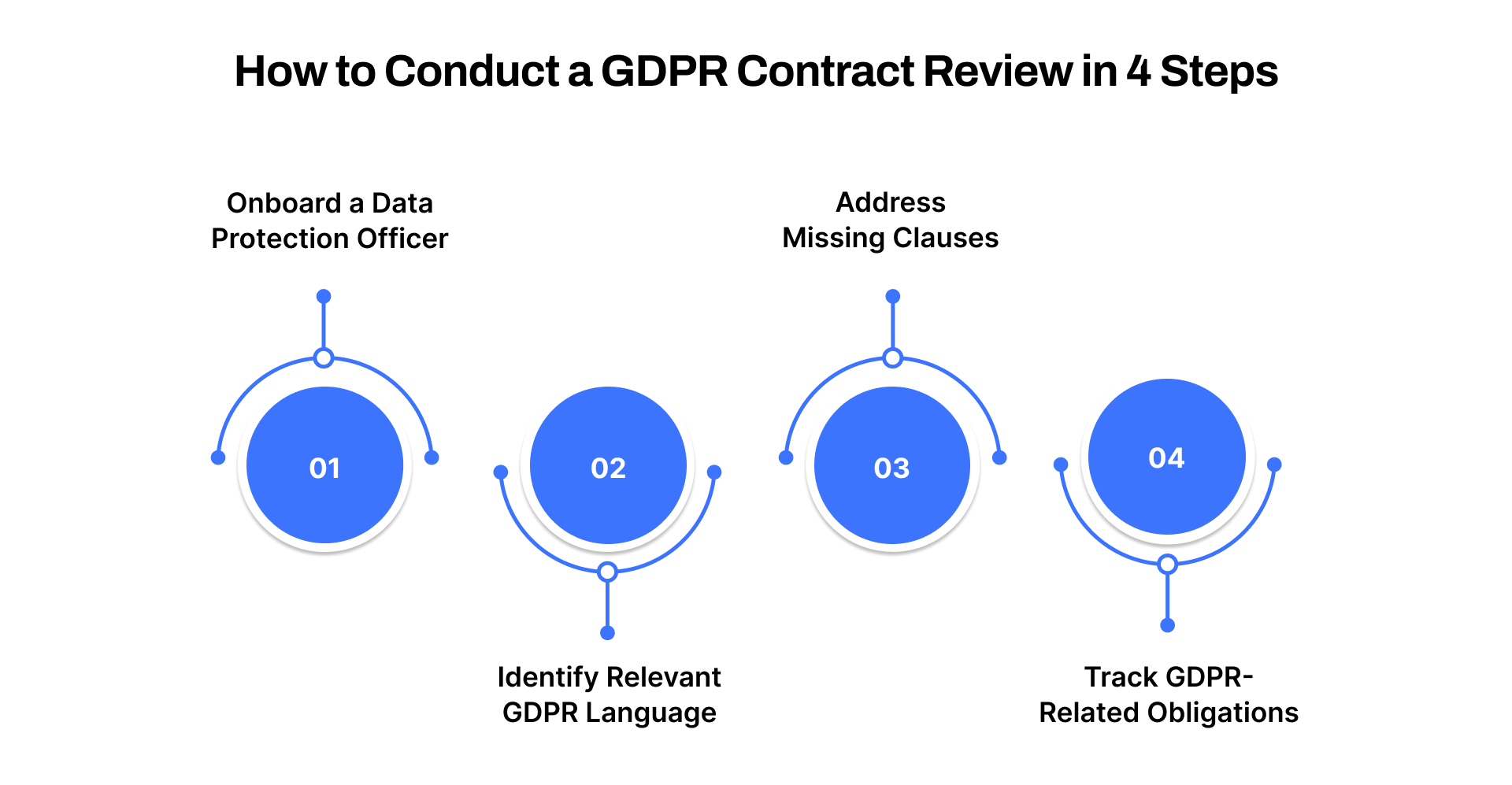
1. Onboard a Data Protection Officer (DPO)
If required by GDPR, appoint a Data Protection Officer to oversee compliance. This is particularly necessary for businesses involved in large-scale monitoring or processing sensitive data.
2. Identify Relevant GDPR Language
Review your contracts to identify clauses related to GDPR requirements, such as Data Protection Addenda (DPAs), Data Protection Impact Assessments (DPIAs), breach notifications, and data subject rights.
3. Address Missing Clauses
If your contract is missing essential GDPR-related clauses, update it immediately. This can include adding provisions for breach notifications, data security measures, or GDPR-compliant international data transfer methods.
4. Track GDPR-Related Obligations
Keep track of all GDPR-related obligations outlined in your vendor contracts. This can be done using contract management software, which helps flag risky or non-compliant clauses across your entire portfolio.
Also Read: Enterprise Risk Management Strategies and Frameworks
Understanding contracts is important, but GDPR’s principles are what truly guide vendor accountability.
7 Core GDPR Principles Vendors Must Follow
The seven principles of GDPR govern how personal data should be processed:
Lawfulness, Fairness, and Transparency - Vendors must collect and process data in a legal, honest, and open manner.
Purpose Limitation - Data can only be used for the specific purpose it was collected.
Data Minimization - Vendors should collect only the data they genuinely need.
Accuracy - Personal data must be kept correct and up to date at all times.
Storage Limitation - Data should only be stored for as long as it is necessary.
Integrity and Confidentiality - Vendors must protect data with strong security measures.
Accountability - Vendors must be able to demonstrate compliance at any time.
These principles directly impact the rights of individuals, rights that your vendors must respect.
Rights of Data Subjects
GDPR grants individuals several rights over their personal data, including the right to:
Access - Individuals can request to see what data is being held about them.
Rectification - They can ask for incorrect or incomplete data to be corrected.
Erasure - Individuals can request deletion of their personal data.
Restriction of Processing - They can limit how their data is used.
Data Portability - Individuals can request their data in a transferable format.
Object to Processing - They have the right to stop certain types of data processing.
Rights Related to Automated Decision-Making - They can challenge decisions made solely by automated systems.
Also Read: Understanding Data Leak Prevention: Key Benefits and Practices
Failing to honor these rights can lead to severe consequences, so let’s examine what happens when vendors slip.
What Happens When Vendors Breach GDPR?
Failure to comply with GDPR can result in severe penalties and long-lasting consequences for your organization. Here are the key risks:
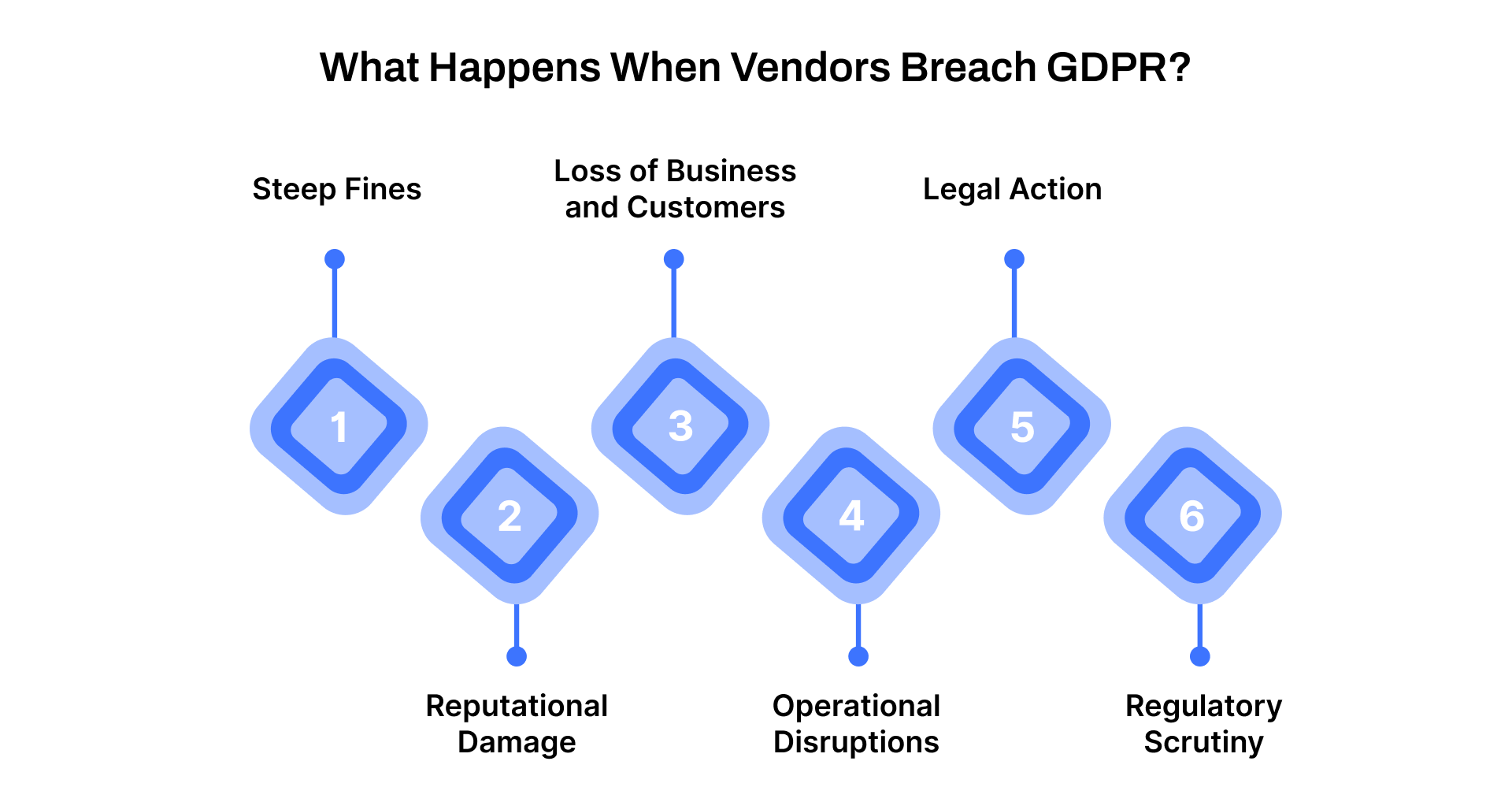
Steep Fines: GDPR imposes substantial fines for violations, with penalties up to 4% of your global annual turnover or €20 million, whichever is higher. These fines can be levied for a range of infringements, from poor data security to inadequate consent practices.
Reputational Damage: A breach of GDPR can lead to significant reputational damage. News of a data breach or non-compliance can tarnish your company’s image, eroding trust among your customers and business partners.
Loss of Business and Customers: Data protection is a top priority for consumers today. Non-compliance could lead to a loss of clients, particularly in industries like healthcare, finance, and education, where personal data is highly sensitive. Customers may choose to take their business elsewhere if they believe their data is at risk.
Operational Disruptions: Dealing with a data breach or non-compliance can disrupt day-to-day operations. You may have to allocate significant resources to rectify the issue, including legal counsel, public relations efforts, and additional compliance audits.
Legal Action: In addition to fines, non-compliance can open the door for lawsuits. Individuals whose rights are violated can pursue legal action against your company, leading to costly settlements or damage claims.
Regulatory Scrutiny: Non-compliance could attract the attention of regulators, who may investigate your data practices more closely. This could lead to additional penalties or even restrictions on processing personal data in the future.
Also Read: Understanding Vendor Onboarding Costs and Their Impact on Efficiency
To stay ahead of these risks, automated monitoring tools can make vendor compliance much easier.

Make Vendor GDPR Compliance Easy with Auditive
Auditive simplifies the process of GDPR vendor contract compliance by offering real-time monitoring, transparent risk assessments, and automated tools to ensure your vendors meet the highest security standards. Here’s how Auditive helps strengthen your GDPR vendor contract compliance:
Contract Monitor: Auditive’s Contract Monitor ensures suppliers comply with contract terms and regulatory requirements, extracting key contract data in seconds, automatically notifying you of renewal deadlines, and flagging any deviations or missed SLAs.
Partner Trust Exchange: Partner Trust Exchange connects you to a dynamic network of thousands of suppliers, continuously gathering real-time risk-relevant information. Vendors can create tailored Trust Profiles, offering transparency and streamlining vendor reviews with up-to-date compliance data.
Accelerated Intake Form: Accelerated Intake Form automates your third-party onboarding process, providing immediate insights into a new vendor’s inherent risk. It categorizes vendors using AI and ensures that GDPR compliance is assessed right from the start.
Questionnaire Copilot: Auditive’s Questionnaire Copilot uses AI to complete over 80% of RFPs and risk questionnaires in minutes, automatically generating responses from your Trust Profile and other sources, making vendor evaluations faster and more accurate.
Supplier Risk Assessment Agent: The Supplier Risk Assessment Agent, powered by AI, speeds up risk evaluations, analyzing vendor data against your custom controls and providing actionable insights and next steps to mitigate GDPR risks swiftly.
Supply Chain Continuous Monitoring: Supply Chain Continuous Monitoring tracks changes and incidents in your supply chain in real-time. Auditive sends notifications for any issues, such as data breaches or vendor disruptions, and updates your risk exposure instantly.
Discover how PayNearMe transformed their security information sharing with Auditive, enhancing efficiency and impressing clients – check out the full case study.
Auditive’s solutions ensure that your GDPR vendor contract compliance process is automated, transparent, and efficient, helping you stay ahead of potential risks.
Wrapping Up
Maintaining GDPR compliance is more than just about avoiding penalties; it creates a culture of trust and security, keeping your business aligned with best data privacy practices. Well-reviewed contracts ensure that third-party vendors meet GDPR standards, protecting your business and customers. By following this checklist, you reduce the risk of non-compliance and build trust with privacy-conscious customers.
To maintain GDPR vendor contract compliance, Auditive ensures that your vendors adhere to GDPR-specific clauses in real-time. Contract Monitor extracts key contract details, monitors any changes, and automatically flags deviations from GDPR requirements. It helps you stay proactive by notifying you of contract renewals and updates, ensuring no compliance issues slip through the cracks.
Reach out to Auditive today for personalized guidance and support to make your GDPR vendor contracts seamless, secure, and compliant.
FAQs
1. How can I ensure my vendor contracts meet GDPR’s data subject access request (DSAR) requirements?
Ensure clauses mandate vendors respond promptly to DSARs and provide full access to data records within legal timeframes, demonstrating their compliance with GDPR.
2. What are the best practices for incorporating GDPR-compliant data breach notification timelines in vendor contracts?
Vendors should be obligated to notify you within 72 hours of becoming aware of a data breach, including detailed information about the breach's nature and scope.
3. Can GDPR compliance clauses in vendor contracts be retroactively enforced for existing contracts?
Yes, GDPR compliance can be retroactively enforced by adding addenda to existing contracts that outline specific data protection obligations under GDPR regulations.
4. How should international data transfers be addressed in vendor contracts to ensure GDPR compliance?
Incorporate Standard Contractual Clauses (SCCs) or Binding Corporate Rules (BCRs) in contracts to ensure lawful international transfers of personal data under GDPR.
5. How do I ensure that third-party vendors handling sensitive data adhere to GDPR's 'data protection by design' principle?
Mandate that vendors implement robust security measures, such as encryption and anonymization, and conduct regular privacy impact assessments as part of GDPR compliance.
