
Best Vendor Compliance Management Software for 2026
75% of organizations now rely on over 50 third-party SaaS vendors, a number that continues to rise with every audit cycle
With that scale, picking the right vendor tools is no longer a preference; it determines how accurately you track controls, verify evidence, and maintain trust across your entire external ecosystem.
This guide breaks down how to evaluate software built for vendor oversight using only measurable criteria, not marketing promises. Each step focuses on clarity, risk visibility, and operational accuracy, making it easier to choose a platform that will still serve you well when your vendor list triples, because for most organizations, it already has.
Quick Glance:
A VRM program works best when risk data stays current, not static.
Gives teams a verifiable, shared source of vendor truth.
Real-time updates reduce review delays and redundant evidence chasing.
Centralized visibility improves risk decisions across security and procurement.
Auditive offers live, continuous insights that strengthen vendor oversight end-to-end.
What Smart Vendor Tools Actually Do for Compliance Management
Compliance management software is built to reduce the manual load of staying aligned with regulatory requirements. Instead of scattered spreadsheets or ad hoc checklists, these vendor tools centralize the operational proof an organization needs to demonstrate that its processes, people, and partners meet applicable standards.
A well-designed compliance system typically supports functions such as
Tracking mandatory certifications and role-based training, ensuring no lapse in required competencies.
Monitoring environmental, safety, and operational standards with real-time status visibility.
Managing audits and inspections by structuring evidence, deadlines, and findings in one place.
Identifying regulatory changes and mapping them to internal controls that need updates.
Supporting risk assessments so teams know where control gaps or vendor exposure exist.
By consolidating these duties, compliance software reduces error-prone work and strengthens the organization’s ability to detect issues before they escalate. It also gives risk, security, and procurement teams a single source of truth, something manual processes and scattered vendor tools rarely provide.
What a Modern Compliance System Actually Covers
A functional compliance system isn’t a paperwork exercise; it’s the set of controls that keeps an organization aligned with regulatory expectations while reducing operational and vendor-driven risks.
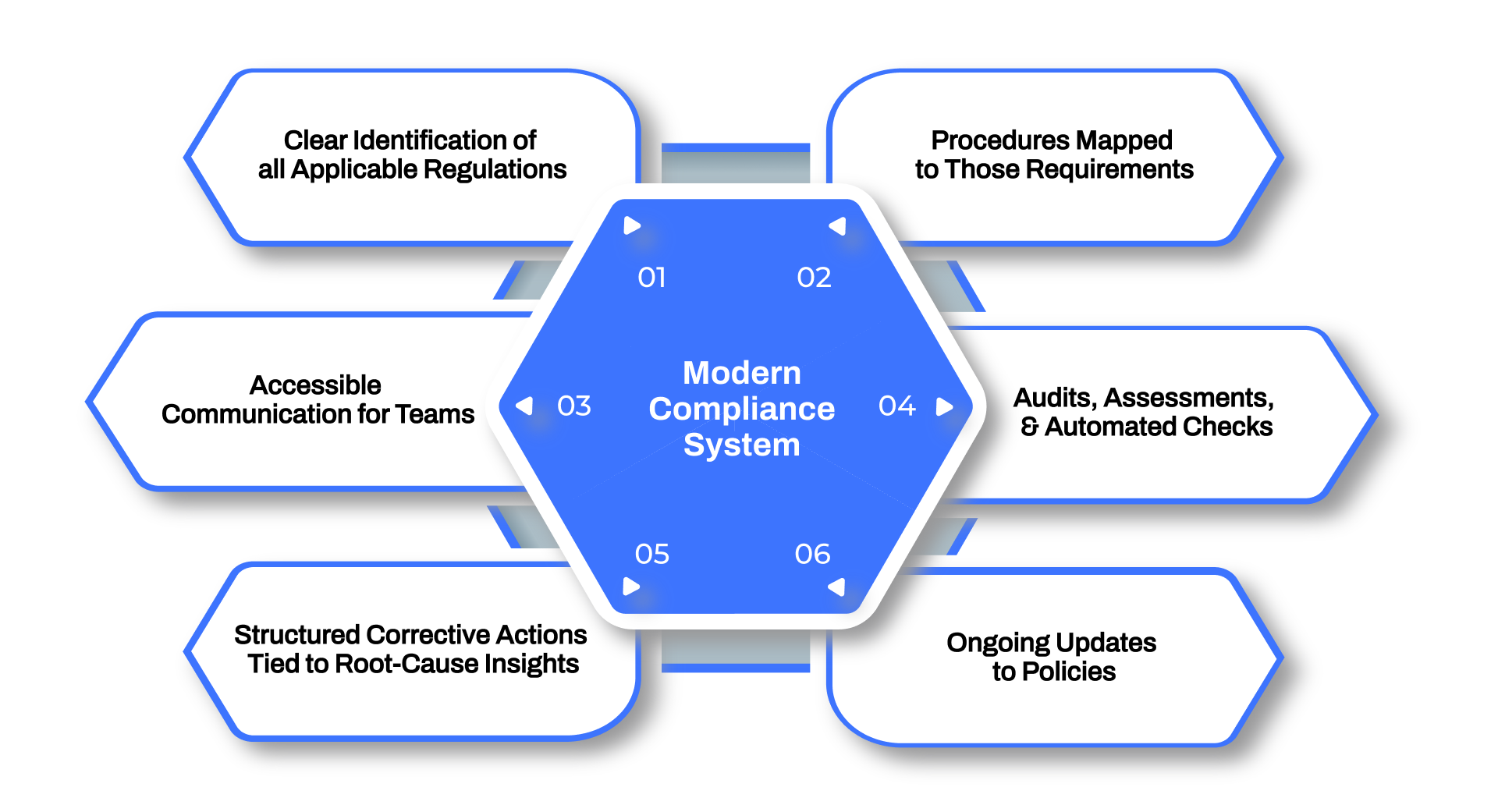
A well-structured system typically includes:
Clear identification of all applicable regulations and industry standards
This includes sector-specific requirements, data-handling rules, and obligations tied to third-party relationships.
Defined policies and procedures mapped to those requirements
Each policy is tied to a control owner, a measurable outcome, and a cadence for review.
Accessible communication for teams and external stakeholders
Notifying internal teams is only half the job; your vendors must also understand expectations, which is where reliable vendor tools help close visibility gaps.
Continuous monitoring through audits, assessments, and automated checks
Manual reviews alone are no longer enough. Organizations increasingly rely on automated evidence capture to cut review time and reduce errors.
Structured corrective actions tied to root-cause insights
Fixing symptoms introduces repeat failures. Mature programs link remediation to clear accountability and measurable deadlines.
Ongoing updates to policies and controls as regulations evolve
Regulatory changes rarely arrive with a long lead time, and outdated internal documentation is now a measurable risk.
Taken together, these activities form the foundation for a compliance environment that can scale without adding unnecessary operational overhead. When supported by the right vendor tools, especially those that unify assessments, evidence collection, and auditability, organizations can maintain accuracy without slowing down teams.
The Best Vendor Tools for Modern Compliance & Risk Teams
As regulatory expectations expand and vendor ecosystems become harder to govern, teams now rely on vendor tools that centralize evidence, automate monitoring, and reduce manual review cycles.
Below is a clean, practical comparison of leading platforms, starting with the one built for teams that need real-time assurance, not checklists.
#1 Auditive
Auditive is a real-time security assurance and risk automation platform designed for teams that want deeper visibility into vendor behavior, not just faster checkbox tasks. Unlike traditional compliance suites, Auditive focuses on continuous control validation, live updates, and evidence-ready vendor insights that reduce audit friction across the entire lifecycle.
Auditive analyzes signals from your cloud, endpoints, identity stack, and vendor workflows, then converts them into verifiable, audit-usable proof without requiring teams to chase screenshots, PDFs, or emails. Its approach eliminates the noise of conventional GRC tools by showing what’s actually happening inside your environment at every point in time.
Auditive is ideal for: Organizations that need validated, ongoing vendor assurance instead of static, once-a-year assessments.
Features
Real-time controls monitoring across cloud, apps, and identity
Automated vendor assurance with live updates
Evidence-ready dashboards, no screenshot chasing
Risk insights tied directly to operational signals
API-driven verifications instead of manual questionnaires
Built-in workflows for vendor reviews and renewals
#2 Vanta
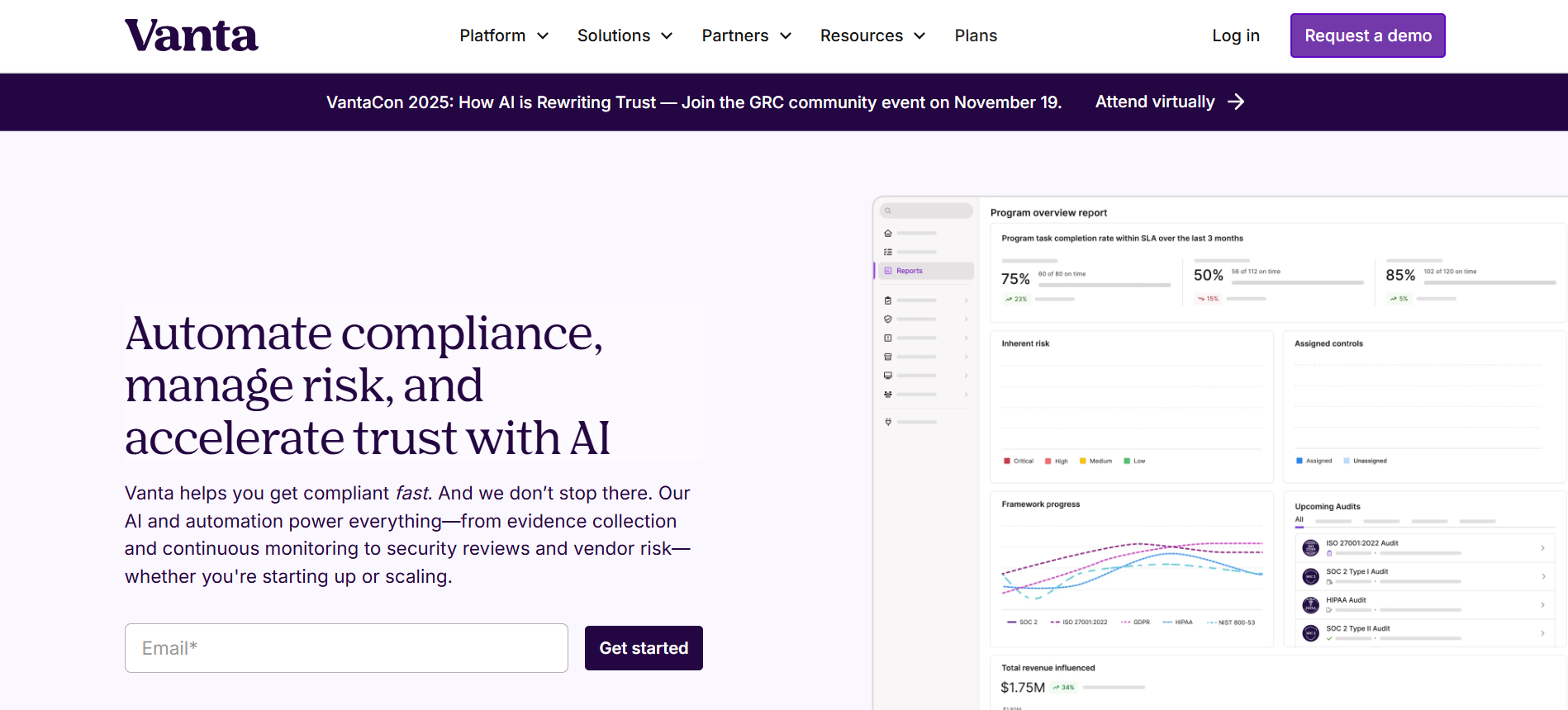
Vanta is a trust management and compliance automation platform that centralizes evidence collection and monitors controls across multiple frameworks. Its broad integration library and AI-assisted workflows streamline audits and help teams operationalize trust as they scale.
Vanta is ideal for: Startups needing fast certifications and enterprises reducing compliance overhead.
Features
Automated, centralized evidence collection
Controls mapped across 35+ frameworks
1,200+ automated tests for continuous monitoring
400+ integrations across cloud, identity, endpoint, ticketing
Policy templates and documentation setups
Sharing control status
In-app audit support and partner network
Foundational security capabilities (risk, personnel, access)
Vanta AI for guided remediation and policy workflows
#3 Drata
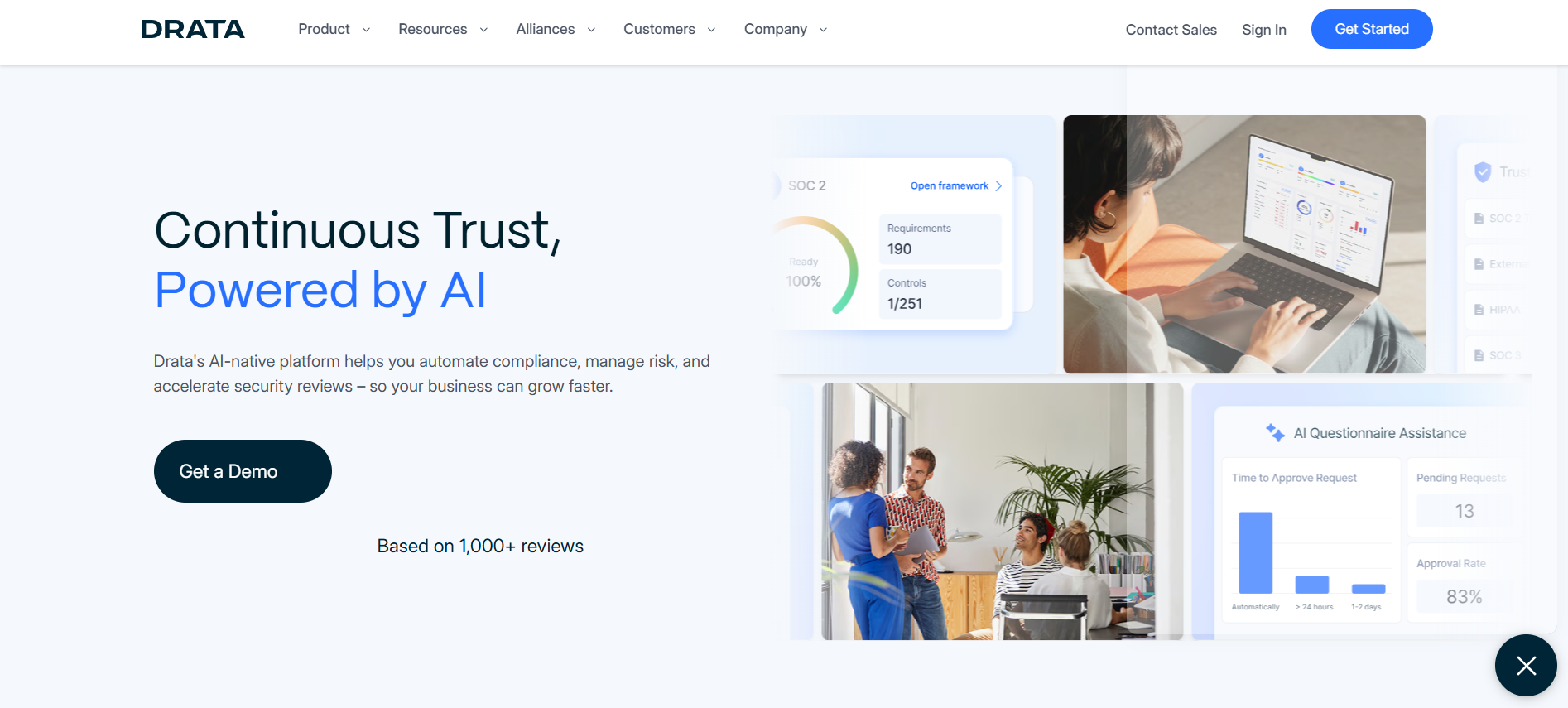
Drata offers a unified GRC platform with emphasis on automation, monitoring, and accelerating security reviews. Its AI-powered workflows help reduce manual processes while maintaining clear audit trails and external posture sharing.
Drata is ideal for: Teams willing to balance some manual tasks with lower tool cost.
Features
Continuous monitoring and automated evidence capture
Prebuilt control library across major frameworks
Risk register and issue tracking
Trust portal for external security visibility
Auditor-oriented reporting and exports
Policy templates and employee adherence tracking
#4 Secureframe
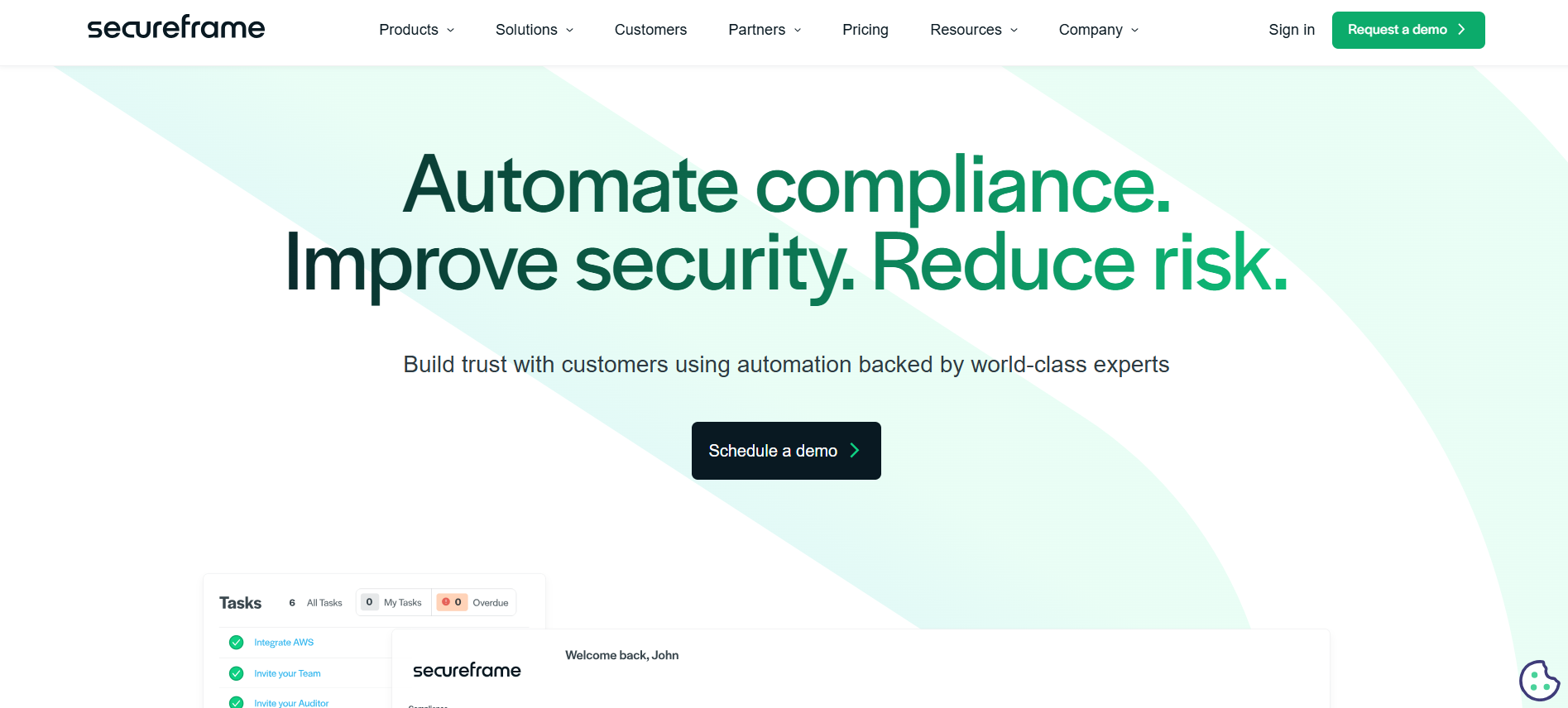
Secureframe supports end-to-end compliance, continuous monitoring, and multi-framework adoption. It’s built for companies scaling vendor oversight and managing multiple security standards simultaneously.
Secureframe is ideal for: Growth-stage companies running multiple frameworks and vendor workflows.
Features
Automated evidence collection and integrations
Continuous monitoring with alerts
Policy library and versioning
Personnel training and access tracking
Auditor collaboration and readiness tools
Multi-framework control mapping
Learn more about: What is Compliance Monitoring: Essential Guide for Definition & Importance
#5 Delve
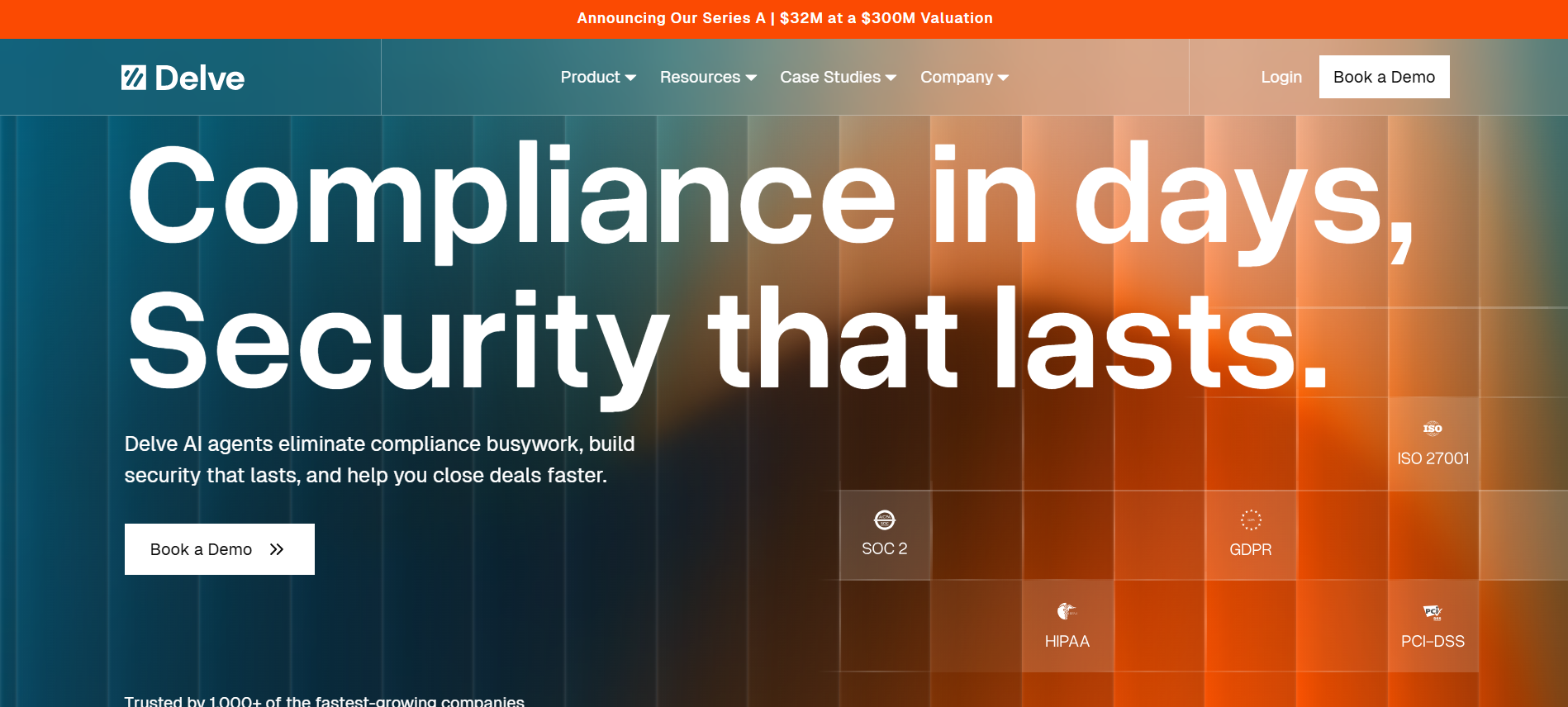
Delve provides compliance automation designed for smaller teams seeking foundational controls, lightweight workflows, and manageable reporting. Its focus is pragmatic compliance rather than large-scale enterprise governance.
Delve is ideal for: Lean teams and early-stage startups getting their first certifications.
Features
Control library mapped to common standards
Evidence repository with assignments and deadlines
Integrations for core cloud and identity systems
Risk register and issue tracking
Lightweight dashboards
Policy templates and attestations
#6 OneTrust
OneTrust provides a broad privacy, risk, and governance suite built for organizations consolidating multiple programs. Its configurable workflows accommodate complex processes across large environments.
OneTrust is ideal for: Enterprises integrating privacy, risk, and compliance into a unified suite.
Features
Configurable assessments and workflows
Policy lifecycle management
Vendor risk and data mapping
Reporting dashboards and analytics
Role-based access and approvals
Enterprise integrations
Most vendor tools automate paperwork. Auditive automates proof. If your VRM process relies on static questionnaires, periodic reviews, or vendor self-attestations, you're operating on assumptions rather than evidence.
Choosing the Right Vendor Tools: A Practical, No-Guesswork Approach
Finding the right compliance management software isn’t about comparing feature lists, it’s about identifying which platform actually removes your operational bottlenecks. Use these checkpoints to select a tool that scales with your audit needs and risk posture.
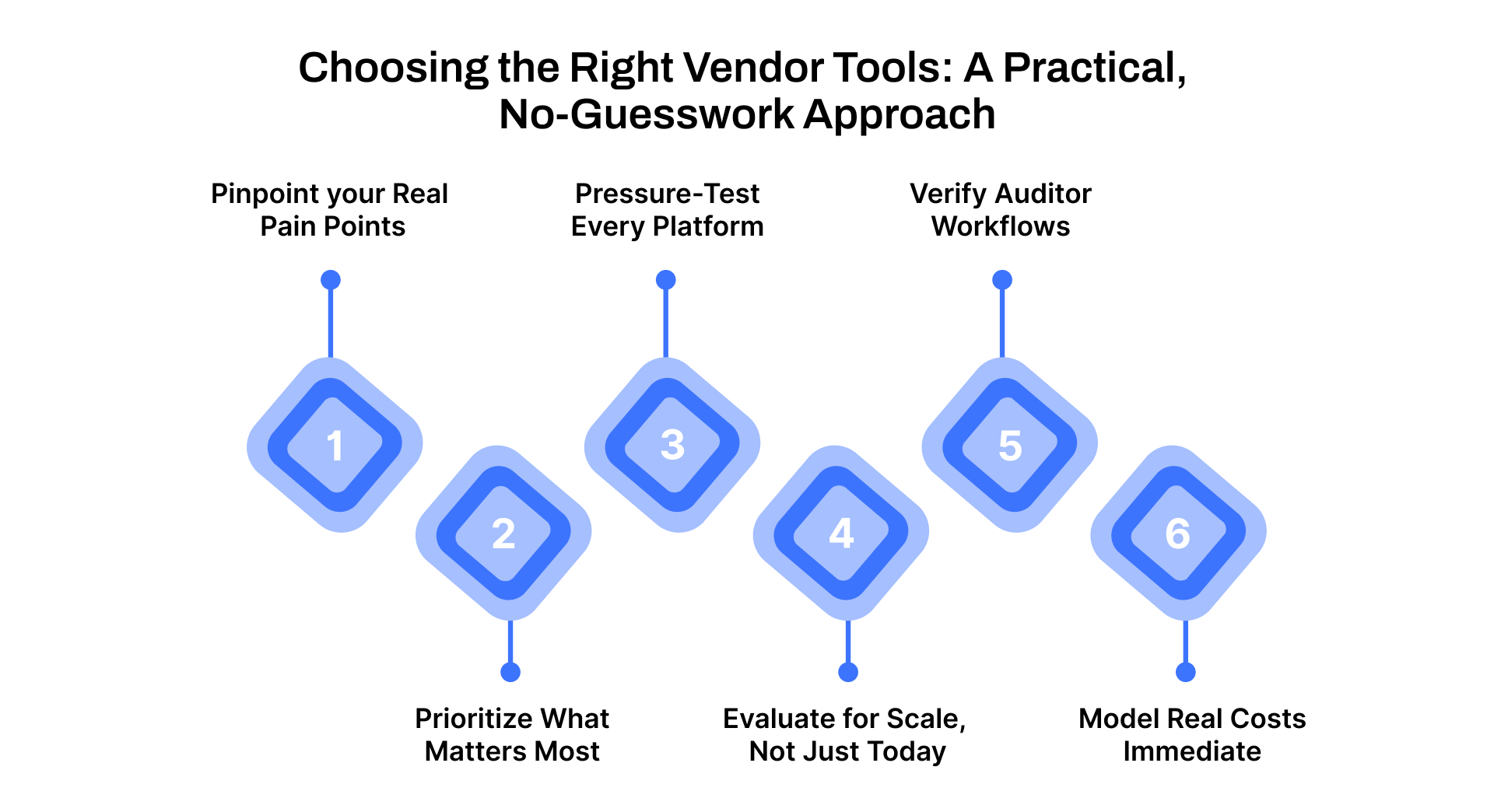
1. Pinpoint your real pain points
Start with an internal audit of your current workflows. Look for the problems you want the software to solve with measurable impact
Manual evidence collection that slows down audits
Duplicate work created by overlapping frameworks
Fragmented vendor reviews are spread across spreadsheets
This step reveals whether you need automation, consolidation, or complete workflow replacement.
2. Prioritize what matters most
Be explicit about your buying criteria.
Do you need the fastest audit cycles?
Do prospects expect trust signals already tied to well-known vendor tools?
Your priorities determine whether you need speed, credibility, depth, or all three.
3. Pressure-test every platform, not in a sandbox
Run a real trial. Connect integrations, trigger evidence pulls, and validate:
Accuracy of automated evidence collection
Integrity of continuous monitoring
Reliability of system-generated controls
Slides and demos won’t reveal gaps, only live data will.

4. Evaluate for scale, not just today
Check if the platform’s capabilities will still work when your risk surface expands. Look for:
Built-in vendor risk workflows
User access reviews that actually automate remediation
Options to plug in pen testing, trust reporting, and risk assessments
Your future state should already be supported on day one.
5. Verify auditor workflows and reporting
Choose software that works with reputable auditors and offers:
In-app evidence review
Streamlined communication
Reliable export formats
This eliminates off-platform back-and-forth and reduces audit friction.
6. Model real costs immediate and long-term
Review pricing for both your current size and your projected growth.
How do costs scale with headcount?
Do new frameworks or vendor tools trigger extra charges?
Transparent pricing now prevents hidden costs later.
Most platforms automate fragments of the process. Auditive automates the whole chain of evidence, vendors, risks, and real-time trust verification in a way that reflects how modern teams actually operate. If your evaluation requires accuracy, automation, and defensible audit trails, Auditive aligns with those criteria without adding operational overhead.
Also read: Understanding Software License Compliance: A Basic Guide
How Auditive Empowers Your Vendor Tools Strategy
When choosing vendor tools for third-party risk, the difference isn’t just automation, it’s continuous, shared trust. Auditive isn’t a static repository; it’s a live ecosystem built around real-time vendor verification and risk insight.
Round-the-clock monitoring: AuditiveX keeps watch on your vendor portfolio 365 days a year, surfacing incidents, certificate changes, and risk shifts without manual prompts.
AI-powered Trust Profiles: Vendors build, and continuously update, their Trust Profiles with AI assistance. That means when they improve or change posture, you see it reflected without chasing them for new uploads.
Streamlined workflows & integrations: Auditive connects with systems you already use, JIRA, Salesforce, and more, so risk signals link directly to your operational tools.
Customized assessments: With AuditiveX Plus, you can deploy tailored questionnaires (SIG, CAIQ, ISO) aligned to your regulatory standards and security frameworks.
Trusted vendor engagement: Because vendors maintain their own trust profiles, they’re more responsive and collaborative. That builds stronger, more transparent partnerships.
Auditive turns your vendor tools from static checkboxes into a dynamic system where risk, trust, and compliance evolve together.
Summary
A strong risk management program only works when every decision is rooted in verifiable data, not assumptions. That’s why the combination of structured VRM workflows and a live update matters; it creates a single source of truth where vendor posture, evidence, and risk signals stay current without constant follow-ups. When your teams can see real-time changes, correlate them with your internal controls, and act on risk the moment it appears, VRM stops being a periodic exercise and becomes an operational safeguard.
Auditive supports this shift by giving organizations an approach that updates itself, a centralized place where vendors maintain their controls, evidence, and security posture continuously. It reduces friction, accelerates reviews, and gives you risk clarity you can rely on at scale.
If you want a vendor risk program that runs with accuracy instead of guesswork, schedule a demo with Auditive and see how real-time trust transforms your third-party oversight.
FAQs
1. What makes a risk management program effective?
Clear objectives, tiered vendor classification, continuous monitoring, and documented decision workflows ensure your VRM process remains measurable and repeatable.
2. How does Auditive support vendor oversight?
It centralizes vendor controls, evidence, and attestations in one place, eliminating scattered documents and outdated information.
3. How often should vendors be reassessed?
High-risk vendors typically require reviews every 6–12 months, while medium- and low-risk vendors can be assessed annually or at renewal.
4. Can automation improve VRM accuracy?
Yes. Automation reduces manual evidence collection, flags changes in vendor posture, and shortens assessment cycles.
5. Why consider Auditive for vendor management?
Auditive provides continuous vendor monitoring, giving teams accurate risk insights without manual follow-ups.
