
GDPR Vendor Management: A Detailed Compliance Guide for Security Teams

Protecting personal data is a core responsibility for your security team, especially as regulators and customers increasingly expect more substantial evidence of compliance.
Under the General Data Protection Regulation (GDPR), you remain accountable for how vendors handle personal data. That means poor oversight, incomplete documentation, or outdated security practices can quickly escalate into serious compliance gaps. Moreover, when you rely on multiple third parties to support your operations, each connection introduces new exposure. This increases the chances of missed risks or delayed responses.
This GDPR vendor management and compliance guide helps you understand why structured oversight matters and how GDPR defines your obligations. It also illustrates the steps you can take to strengthen accountability across every vendor relationship.
In a Nutshell
GDPR applies to every partner vendor touching personal data, making you responsible for their controls, documentation, and data-handling practices.
Effective oversight starts with a structured assessment, aligned with core GDPR requirements: evaluating privacy controls, verifying compliance evidence, reviewing cyber-risk monitoring, and ensuring audit-trail visibility.
Clear processing agreements must define how data is used, which controls must be in place, how breaches are reported, and how sub-processors are approved.
Continuous monitoring reduces compliance gaps, allowing you to track vendor risks, review policy changes, and respond quickly when issues arise or new threats emerge.
Auditive makes GDPR vendor management scalable, offering AI-verified vendor profiles, real-time risk monitoring, and a Trust Center that ensures clear, accurate third-party relationships.
Understanding Why GDPR Basics Matter for Strong Vendor Oversight
Before you can assess your third parties or vendors, you need a clear grasp of what the GDPR requires and why it matters. The regulation is designed to protect the rights and freedom of EU individuals by defining how personal data should be collected, stored, and processed.
To meet GDPR expectations, your team must implement technical and organizational measures such as:
Encryption and secure storage controls
Role-based access management
Regular data backups
Staff training on data protection practices
Consent on data being collected, used, and shared
These measures reduce the chance of unauthorized access, data loss, or accidental exposure.
Also Read: Essential Regulatory Compliance Frameworks in Cybersecurity
Before you can evaluate risks or strengthen oversight, you need a clear understanding of how third parties or vendors fit into your GDPR responsibilities.

Defining Third-Party Roles and Responsibilities Under GDPR
As your organization works to maintain GDPR compliance, the oversight of third parties or vendors becomes just as important as managing your internal controls. These vendors often process personal data on your behalf, which places them under the exact regulatory expectations and leaves you accountable for their actions.
Example: A fintech company partners with a payment verification vendor that processes EU customer data. Say the vendor uses outdated authentication methods and experiences a breach. Regulators will expect the fintech to prove it conducted proper due diligence, set clear security expectations, and maintained ongoing oversight.
What counts as a third-party vendor under GDPR?
A third-party vendor is any external organization that processes personal data for you. Common examples include:
| Vendor Type | What They Handle |
|---|---|
| Cloud service providers | Data storage and system hosting |
| Payment processors | Customer payment and identity details |
| IT support firms | System access for troubleshooting |
Your core responsibilities as a controller
GDPR Articles 24 and 28 place clear obligations on you when working with third parties. As a controller (an organization like yours), you must ensure:
Each vendor provides sufficient guarantees that they follow appropriate security and privacy measures.
You classify and understand every vendor that handles personal data.
Contracts outline data protection requirements, breach-handling procedures, and security expectations.
Vendors only process data based on your documented instructions.
A GDPR-aligned agreement governs all processing relationships.
The added complexity of sub-processors
Vendor oversight becomes more challenging when a processor uses its own third party (a sub-processor). GDPR requires the following:
The processor must obtain your written authorization before engaging a sub-processor.
You must receive advance notice of any changes to sub-processors.
You must have the right to object to a new sub-processor.
The processor must pass down the same contractual obligations to the sub-processor.
If the processor handles data beyond your instructions, it becomes a controller and faces controller-level liabilities.
To stay compliant, you need a structured way to confirm that every vendor touching personal data can uphold the same standards you follow internally. That begins with a clear and consistent approach to assessing their security and privacy posture.
Strengthening GDPR Vendor Management and Compliance Through Structured Oversight
Once you understand third parties' understanding of GDPR, the next step is to build a consistent, repeatable process to evaluate, contract with, and monitor them. For that, you need clear assessment steps, documented evidence, and reliable visibility into ongoing risks. Let's get to the details.
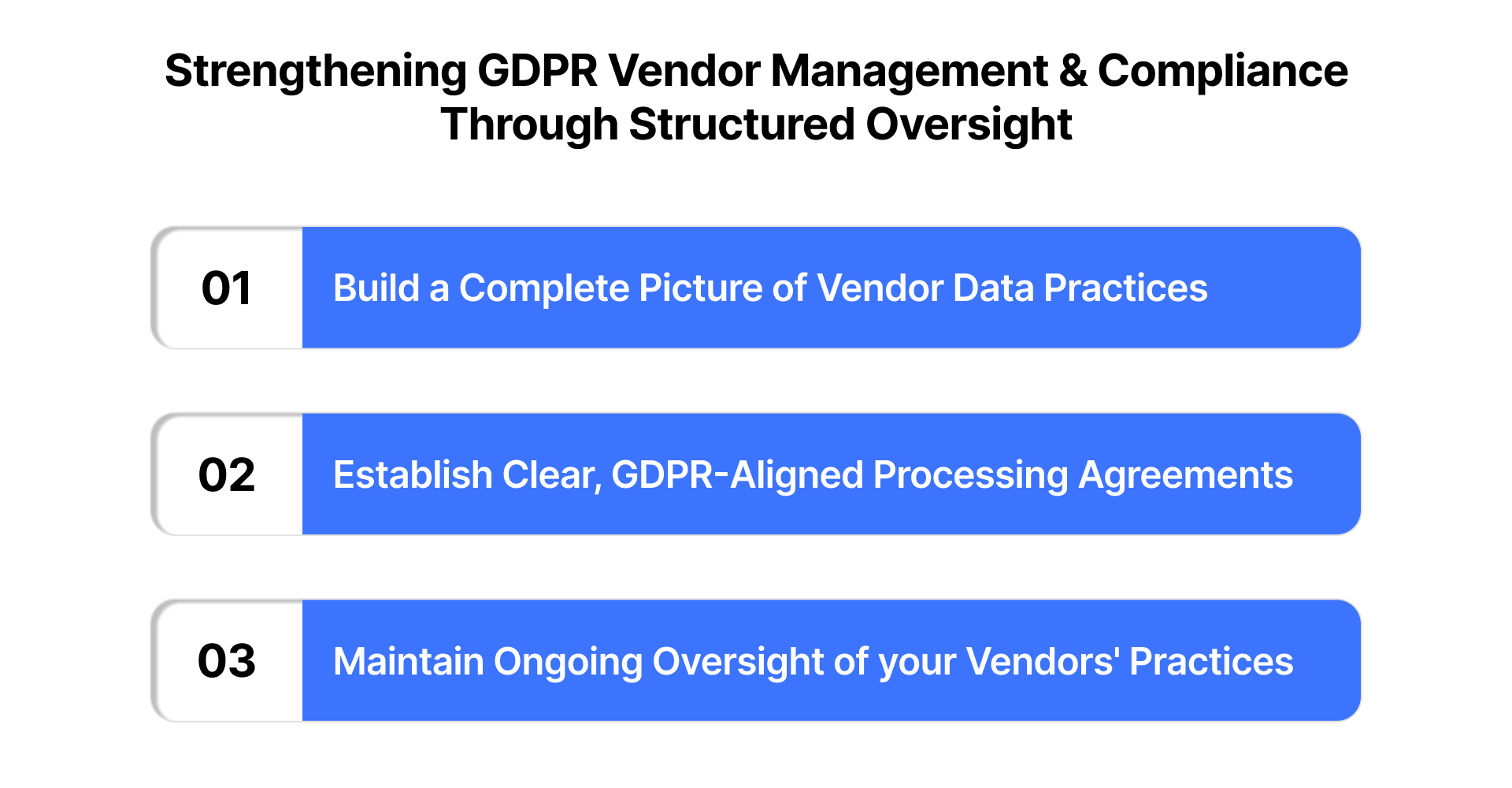
Step 1: Build a complete picture of vendor data practices
Your evaluation should provide a comprehensive understanding of how the vendor processes personal data and whether it can meet GDPR requirements.
Why it matters: A thorough assessment helps you identify weaknesses before onboarding and documents the due diligence that regulators expect.
To simplify your evaluation, align your review with four key GDPR pillars:
Risk evaluation: Evaluate the vendor’s privacy standards, data processing activities, and the safeguards they apply when handling customer information.
Proof of GDPR readiness: Confirm documented security controls and review evidence of regulatory alignment.
Ongoing security oversight: Assess how the vendor monitors cyber threats, identifies vulnerabilities, and manages risks across all high-risk data interactions.
Audit trail transparency: Validate how the vendor maps data movement, logs access, tracks modifications, and maintains clear records of customer data requests.
Key questions to strengthen your GDPR vendor evaluation
A. General GDPR questions:
Do you handle personal data from EU residents?
If yes, what types of personal data do you process? (Financial, healthcare, biometrics, ID numbers, etc.)
Is GDPR considered a strategic priority for your leadership team?
B. Risk assessment questions:
What privacy controls are in place? (Access controls, encryption, MFA, etc.)
Do you process data lawfully and transparently?
Do you meet GDPR requirements for minimization, accuracy, storage, and confidentiality?
Do you provide clear privacy notices to customers?
C. GDPR compliance evidence questions:
How do you document GDPR compliance?
Have you appointed a Data Protection Officer? If yes, provide contact details.
Do you maintain documented incident response procedures?
D. Ongoing security monitoring questions:
Do you have an active cybersecurity risk management program?
Do you work with other vendors who may access customer data?
If yes, how do you monitor the risks associated with those vendor relationships?
What safeguards are in place to detect unauthorized activity?
How quickly can your team respond to a security incident?
E. Audit trail questions:
How do you track who has access to sensitive data?
How do you track all modifications made to personal data?
Where do you log customer data access or deletion requests?
How long do you store audit logs, and who can review them?
F. Additional considerations:
Which other frameworks do you comply with? (CCPA, ISO 27001, NIST Privacy Framework, etc.)
Have you experienced a data breach in the past year?
If yes, what happened, what data was affected, and how was the recovery carried out?
Step 2: Establish clear, GDPR-aligned processing agreements
Once you confirm a vendor’s profile, you need a structured contract that outlines expectations for both sides. Here's what the agreement must include:
Specific processing instructions: Define exactly what personal data the vendor can access and how it may be used, and require written approval before changing any processing activities.
Security measures the vendor must maintain: Set minimum requirements for access controls, testing, and training.
Data retention and deletion requirements: Specify how long data can be stored and require secure deletion, including proof of deletion and controls for backup files.
Breach notification timelines: Require immediate notification, ideally within 24-48 hours, with precise details on scope, impact, and remediation steps.
Your audit and review rights: Ensure you have access to scheduled or ad hoc audits, and to timely responses to assessments whenever risks arise.
Expectations for sub-processor approvals: Require advance notice and approval for any sub-processors, and ensure they follow the same GDPR obligations as the primary vendor.
Step 3: Maintain ongoing oversight of your vendors' practices
Once a vendor is onboarded, your responsibility does not end. GDPR expects your team to maintain active, consistent oversight of how third parties or vendors continue to protect personal data.
What ongoing monitoring should include (from your end):
Periodic compliance monitoring reviews: Evaluate whether the vendor’s controls and documentation continue to meet GDPR requirements.
Annual or biannual audits for high-risk vendors: Verify how vendors focus on technical controls, access rules, and incident readiness.
Real-time alerts for suspicious activity: Track changes in the vendor’s posture, breach indicators, or abnormal activity tied to personal data.
Review of updated privacy or security policies: Review revisions to security or privacy policies to confirm they still support your processing requirements.
Regular check-ins to discuss risks and changes: Meet to discuss system updates, staffing changes, new tools, or operational shifts that may introduce risk.
Key insight for CISOs and security teams: Most GDPR enforcement actions cite poor vendor oversight, not poor internal controls. Continuous monitoring proves your organization takes its obligations seriously.
Example: An EdTech company using an identity verification service should routinely verify that the service continues to implement strict access controls. If an audit shows the vendor added temporary support staff with broad access, the company must act immediately to stay compliant.
Also Read: Vendor Due Diligence Best Practices Guide
Before you can close the loop on vendor oversight, you also need a clear plan for situations where a third party or vendor falls short of GDPR requirements.
Managing Vendors Who Fail to Meet GDPR Expectations
Even with a strong onboarding and monitoring process, some third parties or vendors may still fall short of your GDPR standards. When that happens, your team must respond quickly to reduce exposure and prevent repeat issues.
Understanding the risks of vendor non-compliance
A vendor’s failure to follow GDPR requirements can create significant operational and legal challenges for your organization. These risks often include:
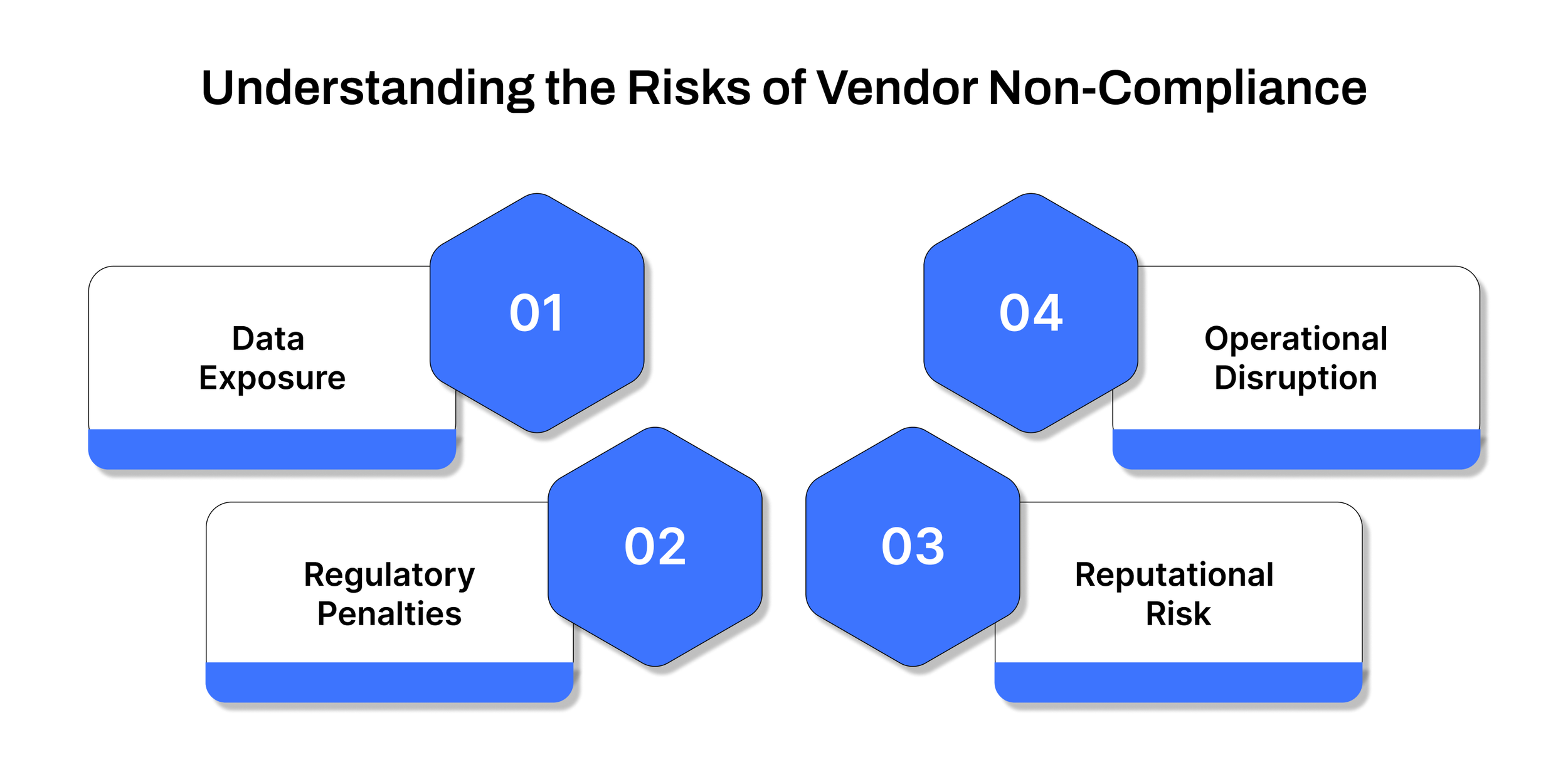
Data exposure: Weak controls can lead to unauthorized access, accidental disclosure, or the loss of sensitive customer information.
Regulatory penalties: GDPR fines apply to the controller, even when the issue originates within the vendor’s systems.
Reputational risk: Customers expect you to protect their data, regardless of where it is stored or processed. So, in case of breaches, you lose their trust and reputation in the market.
Operational disruption: A breach or compliance issue can halt services, delay workflows, or require emergency remediation.
How to address vendor non-compliance effectively
When a vendor fails to meet GDPR requirements, taking prompt, structured action helps contain the risk and maintain trust.
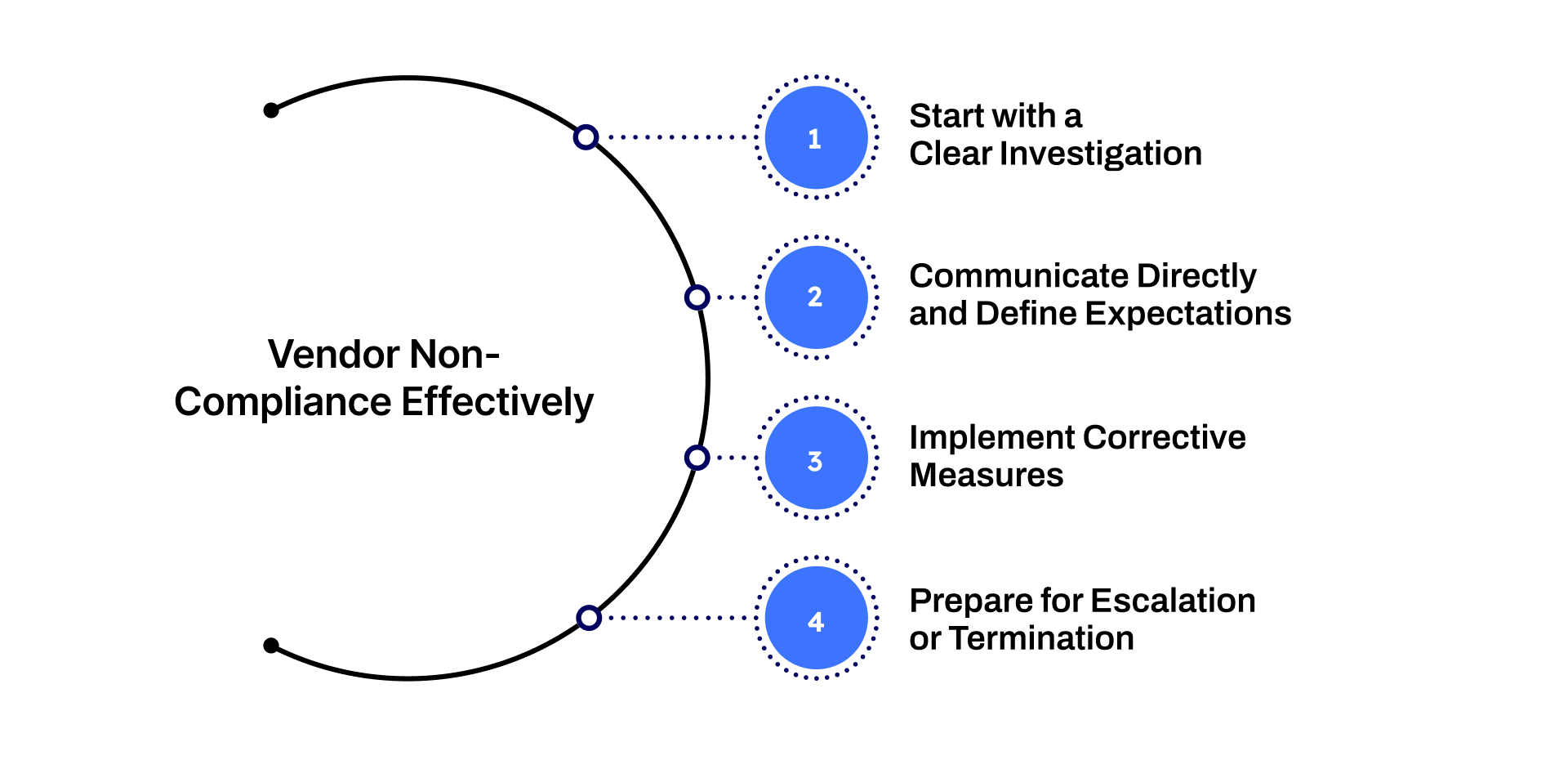
1. Start with a clear investigation
Confirm which personal data or processes were affected.
2. Communicate directly and define expectations
Engage the vendor to understand why the non-compliance occurred.
Clarify required corrective actions and set deadlines for improvements.
Guide if the issue stems from misunderstandings or outdated processes.
3. Implement corrective measures
Request updated controls, strengthened procedures, or revised documentation.
Document the issue with the root cause to support internal reports or regulatory inquiries.
Require retraining for vendor staff when mishandling sensitive data.
Increase monitoring frequency for vendors recovering from a lapse.
4. Prepare for escalation or termination
If the vendor cannot, or does not show signs of meeting GDPR expectations:
Begin transitioning away from them.
Activate contingency plans, such as identifying alternate vendors or shifting work internally.
Ensure all data is securely returned or deleted before ending the relationship.
Also Read: Vendor Offboarding Best Practices and Checklist
As GDPR demands increase and vendor networks expand, you need sharper visibility into third-party risks. Auditive gives you that advantage.
How Auditive Simplifies GDPR Vendor Management and Compliance
Managing GDPR obligations across multiple third parties or vendors can be overwhelming, especially when you need accurate data, continuous oversight, and fast responses to risks. Auditive simplifies this process by giving your team real-time visibility, automated assessments, and trustworthy security evidence, without the manual workload.
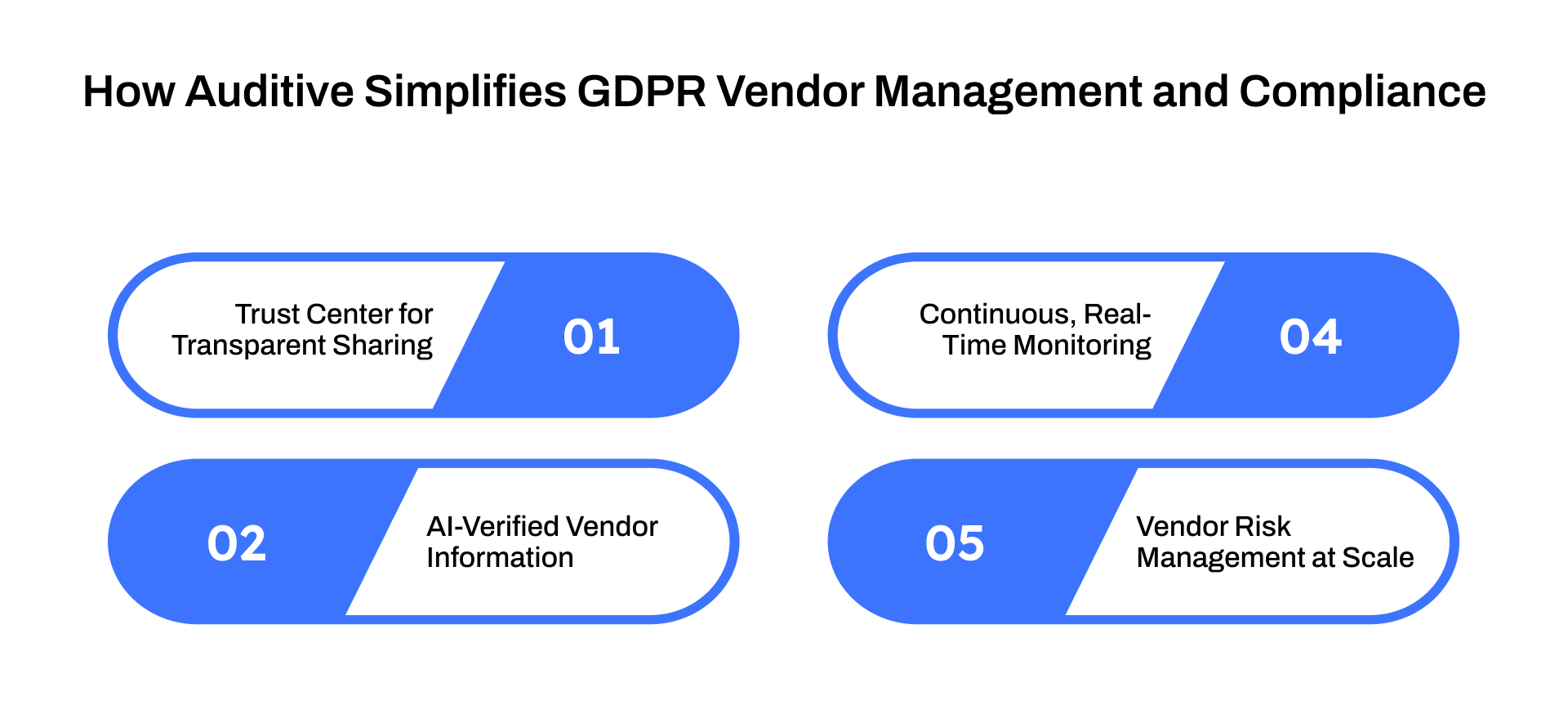
Here's why Auditive is a more intelligent choice for GDPR-focused vendor oversight:
Accelerated Intake for Faster Vendor Reviews: Our intake workflow gathers the right security information from vendors upfront, reduces back-and-forth, and standardizes how your team collects GDPR-related details. This makes early assessments faster and more reliable.
AI-Verified Vendor Risk Assessment: Auditive validates profile details using AI to confirm accuracy, highlight risks and inconsistencies, and reduce your reliance on self-reported claims.
Continuous, Real-Time Monitoring: With continuous tracking of vendor security posture, the tool alerts your team the moment a vendor’s risk level changes or a potential incident arises. This lets you act before issues impact GDPR compliance.
Vendor Risk Management at Scale: Assess vendor risk quickly and consistently, using a system built to evaluate many vendors at once. This helps your team stay ahead of GDPR obligations without slowing down business operations.
Together, these capabilities make compliance with third-party GDPR vendors easier to manage, verify, and maintain.

Final Thoughts
GDPR sets strict requirements for managing personal data, and those requirements apply equally to every third party or vendor involved in your operations. As you onboard more external partners, the challenge shifts from managing your own controls to ensuring each vendor can uphold the same standards.
A structured GDPR vendor management approach helps your team maintain this accountability. Auditive supports this by giving your team the visibility and assurance needed to manage vendors confidently. It enables you to understand each vendor’s security posture, stay informed of changes, and maintain trust across every data-processing relationship.
Book a demo now to strengthen your GDPR compliance process with smarter third-party oversight.
FAQs
1. Does GDPR apply to US or Canadian companies?
Yes. GDPR applies to US and Canadian companies that offer goods or services to individuals in the EU or process the personal data of EU residents.
2. What are the seven GDPR requirements?
The 7 GDPR principles are lawfulness, fairness, and transparency; purpose limitation; data minimization; accuracy; storage limitation; integrity and confidentiality; and accountability. These principles guide the collection, processing, protection, and documentation of personal data.
3. What makes a third-party vendor’s claim trustworthy?
Self-attestation alone is insufficient; vendors should provide verifiable proof showing their data protection commitments in practice. Look for evidence that is independently validated, such as certifications, test reports, audit summaries, and documented controls.
4. How can we reduce onboarding delays caused by GDPR reviews?
Use standardized questionnaires, automated assessments, and clear processing criteria to speed up evaluations. Pre-approved vendor tiers and continuous monitoring also reduce the need for repetitive checks during renewals.
5. Can small vendors still be considered high-risk?
Yes. Risk depends on the type of data processed, not vendor size. Even a small SaaS tool can be high-risk if it handles identity data, behavioral information, or sensitive records.
6. What happens if a vendor uses a tool we didn’t know about?
Unknown tools, often introduced through embedded services, can create unapproved data flows. Investigate immediately, request documentation, and assess whether the tool meets GDPR requirements. If risks remain, require removal or escalate to contractual remedies.
